Solana vs Ethereum (2026): Fees, Speed, Security & Which Is Better
Compare Solana vs Ethereum in 2026 across architecture, fees, speed, decentralization, and ecosystems. Discover which blockchain fits your app or investment strategy with clear data, use-case guides, and future roadmaps.
Solana is a high-throughput Layer-1 blockchain. It uses Proof-of-Stake with Proof-of-History and a parallel runtime to process many transactions at once. Fees are tiny, and finality is fast.
Ethereum is a smart-contract platform secured by Proof-of-Stake. The base Layer-1 focuses on security and settlement. Most scaling happens on Layer-2 rollups that batch and post data back to Ethereum.
Under the marketing buzz, these chains feel very different to build on. One rewards ultra-fast, low-cost loops; the other wraps you in liquidity, standards, and conservative security.
In this guide, we translate jargon into trade-offs so you can pick a side or go multi-chain without guessing, based on fees, latency, and risk.
Key Takeaways
- Solana is built for speed with sub-second block times, confirmations in a few seconds, and sub-cent fees.
- Ethereum offers deeper liquidity, strong security, and broad EVM adoption.
- Ethereum scales with L2 rollups; Solana scales natively on its L1.
- Ethereum has higher client diversity and decentralization today.
- Solana excels in consumer apps, gaming, and real-time trading.
- Ethereum dominates institutional DeFi and blue-chip NFTs.
- ETH can be deflationary with high activity; SOL relies on inflation decay plus fees.
- Your choice depends on app type: fast UX vs institutional trust.
- Multi-chain strategies often give the best balance of speed and liquidity.
Key Differences at a Glance
See where each chain wins by dimension. Use this to pick fast.
| Dimension | Solana | Ethereum / Ethereum+L2 |
|---|---|---|
| Architecture | Monolithic L1 (single high-throughput chain). Simple UX. | Modular L1 with L2 rollups (execution off-chain, settle on L1). Flexible stack. |
| Scaling path | Native L1 scale (parallel runtime, local fee markets). | L2 rollups scale execution; L1 handles security and settlement. |
| Consensus / runtime | PoS + Proof-of-History; Sealevel for parallel execution. | PoS; EVM on L1 and L2s. |
| Finality (typical) | User confirmations in a few seconds; sub-second block times under normal conditions | Seconds on major L2s; longer on L1 during load. |
| Fees (typical medians) | Sub-cent for most transactions. | Sub-cent to low cents on L2s; higher on L1 during peaks. |
| Throughput (practical) | Hundreds to low-thousands TPS sustained; higher bursts possible. | L1: tens of TPS. L2s: thousands+ TPS across many rollups. |
| Client diversity & resilience | Growing diversity (Agave/Jito, Firedancer progress). | Mature multi-client set on execution and consensus layers. |
| Decentralization levers | Higher hardware demand; many independent validators. | Large validator set; client diversity strong; stake pool concentration risk exists. |
| MEV approach | Jito bundles; priority fees. | MEV-Boost today; PBS on roadmap. |
| Tokenomics | Inflation decay over time; staking yields fund security. | EIP-1559 burn plus low issuance; can be net-deflationary under demand. |
| Ecosystem maturity | High-throughput consumer apps, NFTs, memecoins rising. | Deep DeFi TVL, broad dApp base, institutional traction. |
| Best-fit apps | Consumer, gaming, payments, on-chain order books. | Institutional DeFi, RWAs, compliance-heavy apps, EVM portability. |
Architecture Explained- Why Solana Is Faster & How Ethereum Scales?
Solana pushes single-shard performance. Ethereum scales execution on L2 while L1 secures settlement.
Solana (How It Works)
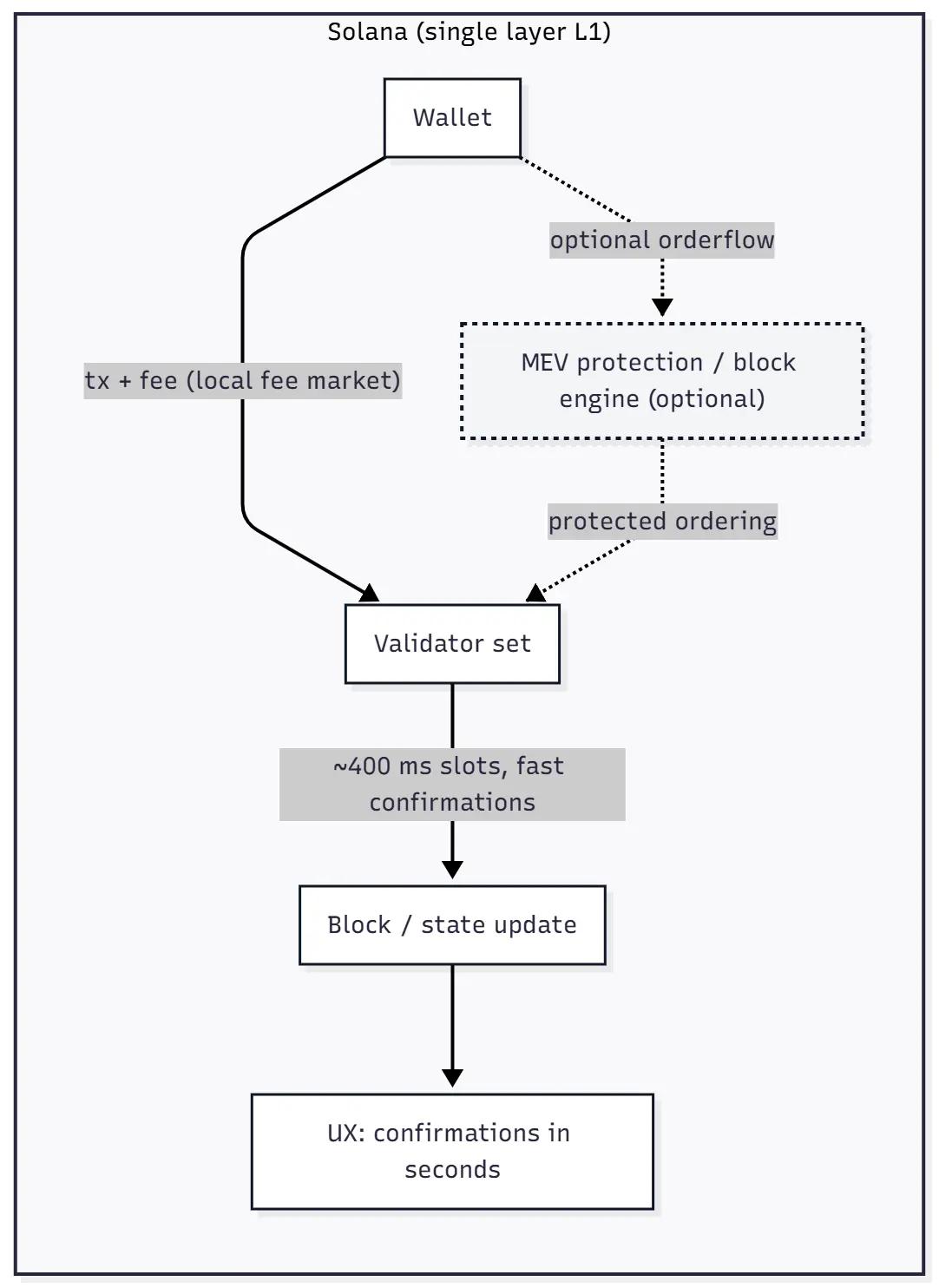
- Proof-of-Stake + Proof-of-History.
- Sealevel runs transactions in parallel across cores.
- Local fee markets reduce congestion spillover.
- 400ms target slot time; confirmations land in seconds in practice.
- Single layer = simple composability across apps.
Run Solana & Ethereum On Your Terms
Stop trusting shared RPC and random nodes. Launch dedicated Solana and Ethereum servers on RedSwitches with low latency, DDoS protection, and global locations ready to deploy.
Ethereum (How It Works)
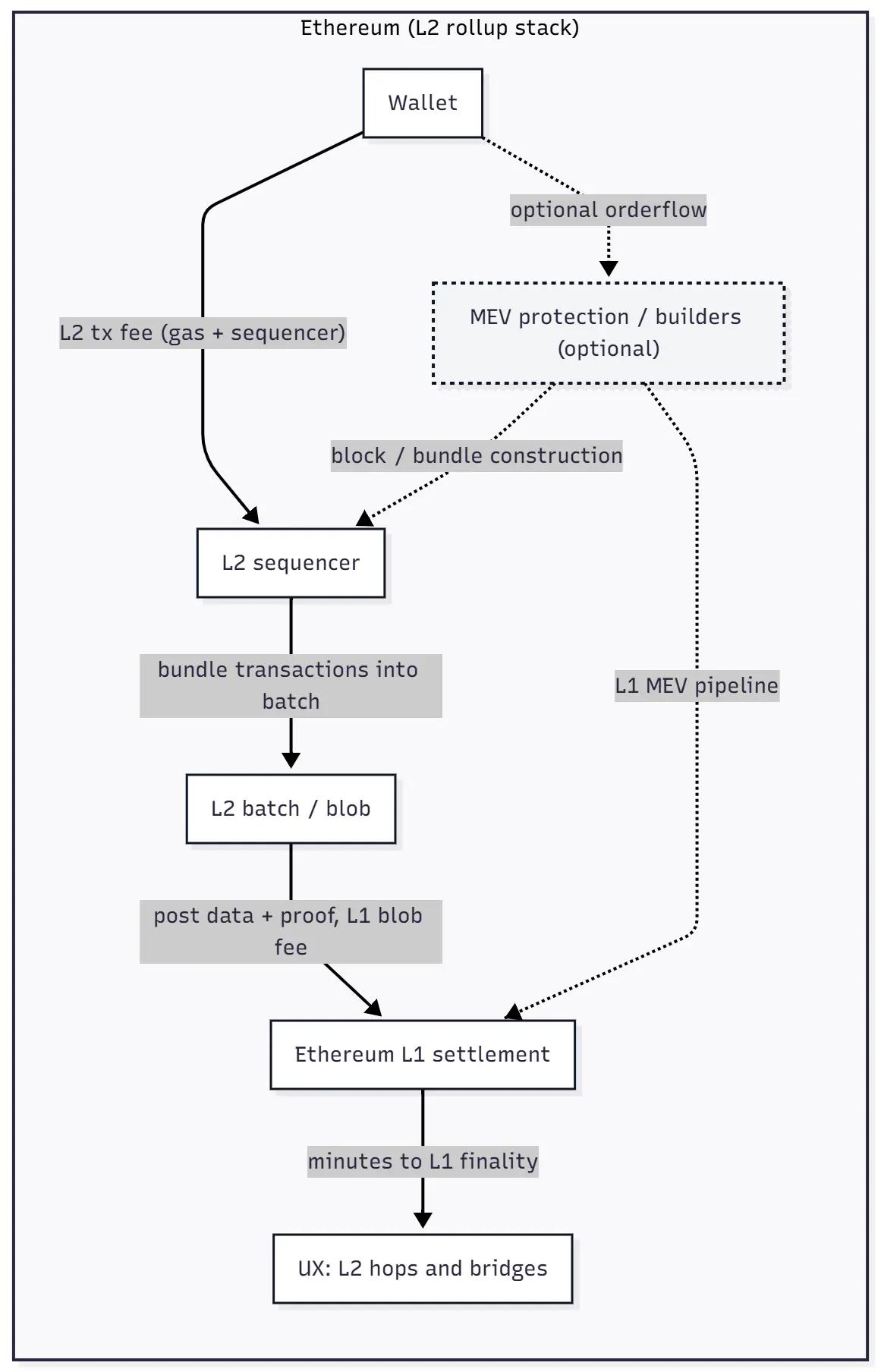
- L1 focuses on security and settlement.
- L2 rollups execute transactions, then post data back to L1.
- Blobs cut L2 data costs after Dencun; L2s carry most throughput.
- Time on L1 uses 12-second slots; full finality takes minutes.
Why Is Solana Faster Than Ethereum?
- Parallel execution on a single shard.
- Short slots and tight propagation targets.
- No L2 hand-offs in the critical path.
Ethereum L2 Scaling vs Solana
- Ethereum scales “out” via many L2s.
- Solana scales “up” on one L1.
- Your trade-off: L2 hops and bridges vs one-chain simplicity.
Performance & Fees Users Actually Feel
Use real numbers with dates. Then map the impact to trading, gaming, and payments.
| Chain | Typical fee (USD) | Confirmations/finality (s) | TPS (practical) | Block/slot time | Notes |
|---|---|---|---|---|---|
| Solana L1 | ~$0.0002–$0.001 (USD, typical Q4 2025) | ~2–5 | Hundreds–low-thousands | ~0.4 | Base fee per sig + optional priority fee; still sub-cent most days. |
| Ethereum L1 | ~$0.25–$0.45 avg (2025) | User confirmations: seconds; economic finality: ~12–13 minutes (~2–3 epochs) | 10–30 | 12 | Use L1 mainly for settlement; prefer L2s for routine activity. |
| Base (L2) | ~$0.01–$0.05 | ~2–10 | Thousands+ (ecosystem) | seconds | Fees dropped post-Dencun (as observed in 2025 dashboards); priority fee dynamics still matter during peaks. |
| Arbitrum (L2) | ~$0.02 median (post-4844 study) | ~2–10 | Thousands+ (ecosystem) | seconds | Big reduction after blobs; varies with demand. |
| Optimism/OP Stack (L2) | cents-level | ~2–10 | Thousands+ (ecosystem) | seconds | Similar profile; check current dashboards for spikes. |
Ranges reflect typical conditions as of Q4 2025; fees can spike under load. Always re-sample and time-stamp your numbers before publishing.
What Does This Mean For You?
- Perps and order books: You want tight finality and fee predictability. Solana’s single-layer path helps you hit low-latency targets; leading Ethereum L2s are viable if your users sit in the EVM world. If you’re running validators or high-traffic RPC endpoints, consider Solana-optimized RPC and validator servers for consistent low latency.
- Gaming and real-time UX: Sub-second feedback loops convert better. Solana’s short slots help here; fast L2s can work if you manage bridges and sequencer risk.
- Payments and micro-tx: Cents vs sub-cents change unit economics. On Solana, sub-cent fees fit high-frequency flows; on Ethereum, L2s keep EVM flows affordable.
Reliability & Client Diversity (Uptime & Resilience)
Ethereum’s multi-client model contains failures. Solana’s stability is improving as client diversity grows.
- Solana has had several multi-hour network halts over the last few years, including a ~4.8-hour outage in February 2024.
- The team focused on scheduler fixes, fee markets, and network hardening.
- A second validator client entered the mix and is moving toward wider use.
- Ethereum avoided chain-wide halts because issues on one client did not stop the network.
What “client diversity” means for you
- Different client teams build the same protocol independently.
- A bug in one client affects only that slice of the network.
- More clients → lower systemic risk.
Matrix: production client options to track
- Ethereum (Execution): Geth, Nethermind, Erigon.
- Ethereum (Consensus): Prysm, Lighthouse, Teku.
- Solana: Agave/Jito today (dominant mainnet client). Second client (Firedancer) moving through testnet and phased mainnet adoption.
Builder watch-list
- Client share dashboards: watch the % split across clients.
- Release cadence: prefer clients with active, well-tested releases.
- Incident post-mortems: look for root-cause clarity and mitigation steps.
- Your own redundancy: run diverse clients where possible; spread regions and providers.
- Alerting: monitor fork choice, missed slots, and peer counts per client.
Decentralization & Security Budget – Who’s More Decentralized?
Judge decentralization by multiple criteria: validator diversity, client diversity, stake concentration, and hardware accessibility.
- Validator diversity: number of validators, geographic spread, and independence.
- Client diversity: production-grade options and their share.
- Stake concentration: how much stake large pools or operators control.
- **Hardware accessibility:**on Solana, validators typically run high-end machines (e.g. 12+ cores / 24 threads, 256 GB+ RAM, fast NVMe); on Ethereum, a full node + validator can run on more modest hardware (e.g. 4–8 cores, 16–64 GB RAM).
- Data availability and censorship resistance: ability to include transactions under stress.
- Upgrade governance clarity: transparent processes reduce coordination risk.
How to read the trade-offs
- Validator counts vs hardware:
- Lower hardware needs invite more home and small operators.
- Higher hardware needs can raise performance, but narrow who can join.
- Stake distribution:
- Large pools reduce operational friction for you.
- They also raise concentration risk; watch the pool share and delegation rules.
- Client options:
- Multiple production clients lower the correlated failure risk.
- Single-client dominance raises the blast radius during a bug.
Which blockchain is more decentralized, Solana or Ethereum?
- If you prioritize client diversity and a broad validator base, Ethereum holds the edge today.
- If you value single-shard performance and are comfortable with higher validator hardware targets, Solana shows progress as a second client gains traction.
- Your call should weigh stake concentration, client share, and your ability to run independent nodes.
MEV & User Impact – Jito vs MEV-Boost / PBS
MEV is profit captured by reordering, inserting, or censoring transactions. It changes what you pay or receive. Both ecosystems ship tools to reduce harm.
- Searchers look for profitable opportunities inside a block.
- They try to place their transactions before or after yours.
- This can raise your swap price, steal your arbitrage, or worsen slippage.
- You feel it as higher cost, missed fills, or unexpected reverts.
Ethereum Today (Mev-Boost, an Out-Of-Protocol Pbs Implementation → Pbs Research)
- Flow: wallets → relays/builders → block to proposer.
- Goal: separate block building from proposing to limit validator abuse.
- Wins: strong builder competition, better prices for validators, fewer chain-wide failures.
- Risks to watch: builder concentration, relay trust, censorship during spikes.
- Roadmap: enshrined PBS moves core parts into the protocol to cut reliance on external relays and improve censorship resistance.
Solana Today (Jito, Bundles, Priority Fees)
- Flow: wallets can submit bundles that must land together.
- Priority fees: you attach tips so validators include you earlier.
- Wins: fast inclusion for latency-sensitive flows like perps and NFTs.
- Debates: how to share priority fee revenue fairly across the network.
- What to track: Jito share, inclusion behavior during congestion, bundle failure rates.
User Impact Box (What Changes Your Outcome)
- You pay more when a backrun pushes price up before your swap.
- You receive less when a sandwich captures spread around you.
- Settlement risk rises during mints, liquidations, and perps volatility.
Remedies You Can Use Today
- Private order flow / protected RPC: cut public mempool exposure where supported.
- Tighter slippage + limit orders: cap worst-case fills.
- Batching or bundling: reduce leak points between steps.
- Latency budgets: place nodes close to builders/validators; watch queue times.
- Wallet choice: pick clients that surface MEV controls, tips, and simulation.
Tokenomics & Staking – Burn vs Inflation
ETH can turn net-deflationary when on-chain activity is high. SOL uses a declining inflation schedule that funds staking and nudges more of the security budget toward fees over time. This frames solana vs ethereum long term.
Eth: Burn, Issuance, and When Net-Deflationary
- EIP-1559 burn: the base fee of each transaction is destroyed.
- Issuance: validators earn new ETH plus priority tips.
- Net issuance condition: when burn > issuance, supply shrinks.
- What drives this: gas usage, base fee levels, and the percent of fees burned.
- Result you care about: heavy activity can lower supply while still paying validators.
SOL: Inflation Decay, Staking Apy, Security Budget
- Inflation decay: annual issuance steps down toward a long-run rate.
- Staking yield: comes from inflation + priority fees.
- Security budget: as on-chain fees rise, reliance on inflation can fall.
- Validator economics: hardware costs are higher; fee growth helps offset them.
- Result you care about: stable fee volume supports security with less dilution pressure.
Mini Worked Example (Light Math, No Jargon)
- I = new coins issued in a year.
- B = coins burned in a year.
- F = fees paid to validators (not burned).
- ETH net change ≈ I − B. If B is large, supply can shrink.
- SOL net change ≈ I − burned fee share (burn is smaller), while the remaining fees (plus tips) pay stakers and validators.
- Your lens: higher B lowers supply; higher F raises security without extra dilution.
Long-Term Implications for Value and Security
- ETH: activity can make supply contract while keeping validator rewards viable.
- SOL: scheduled inflation declines while fee share grows; more fee-funded security over time.
- For both, sustained fee volume is the key signal.
- Watch: issuance schedules, fee share to validators, and real usage that pays for blockspace.
Ecosystem Reality, DeFi, NFTs, Consumer Apps
Ethereum leads on institutional DeFi and blue-chip NFTs. Solana leads on high-throughput consumer UX.
DeFi, Solana vs Ethereum for DeFi
- Ethereum offers deeper liquidity and mature risk tools. You get broad asset coverage and audit history.
- Solana delivers low fees and fast settlement. You get smoother perps and on-chain order books at scale.
- On Ethereum, L2s add speed and lower fees, but you manage bridges and fragmented liquidity.
- On Solana, single-layer composability keeps routing simple during volatile markets.
- Ask yourself: do your users value deeper liquidity or faster fills?
What to highlight
- Market depth vs execution speed.
- Routing complexity across L2s vs single-shard swaps.
- Fee certainty during spikes.
NFTs, Solana vs Ethereum for NFTs
- Ethereum anchors blue-chip collections and high-value trades. You tap larger collector bases and curated marketplaces.
- Solana supports low-fee minting and frequent listing activity. You reach retail buyers and have a faster turnover.
- On Ethereum, L2s help with mint costs, yet top liquidity often remains on L1.
- On Solana, near-zero fees enable large drops and rapid secondary flips.
- Ask yourself: Are you aiming for prestige trades or high-velocity mints?
What to highlight
- Creator economics at different price tiers.
- Mint scale vs collector credibility.
- Settlement speed during hyped drops.
Consumer Apps (Memecoins, Gaming, Depin, Payments)
- Memecoins and social tokens: Solana’s speed and fees fit viral bursts.
- Gaming: sub-second feedback loops boost retention; Solana helps here.
- DePIN and high-frequency data: low fees make continuous writes viable on Solana.
- Payments and micro-tx: Solana’s cost model supports dense activity; Ethereum L2s can work if you accept bridge steps.
| Area | Where Solana leads | Where Ethereum (+L2) leads |
|---|---|---|
| Execution speed | Real-time trading, gaming loops | Fast enough on L2s for most dApps |
| Fees at scale | Micro-tx, large mints | Cents-level on L2s; higher on L1 peaks |
| Liquidity depth | Growing | Deeper for DeFi blue chips |
| NFTs focus | Retail velocity, low-fee drops | Blue-chip liquidity, higher-value trades |
| Composability | Single-layer routing | Cross-rollup with bridge tooling |
| Ops overhead | Lower (one L1) | Higher (multi-L2 routing/monitoring) |
Developer Experience & Ops (DX)
Ethereum excels in tooling, audits, and observability. Solana excels in single-shard composability and Rust performance. L2 fragmentation adds ops cost on Ethereum.
| Dimension | Solana | Ethereum / Ethereum+L2 |
|---|---|---|
| Tooling maturity | Strong SDKs and indexers; Rust dev flow | Broadest tools, libraries, frameworks |
| Audits ecosystem | Growing Rust audit base | Large audit market and standards |
| Indexers / analytics | High-throughput indexers; real-time focus | Rich dashboards across L1 and L2s |
| Language fit | Rust first; C/C++ options | Solidity first; TypeScript-heavy tooling |
| Composability | Single-layer calls keep paths short | L2 choice adds design decisions |
| L2 fragmentation overhead | Not applicable | Bridges, sequencers, liquidity splits, and sequencer centralization risk to manage |
| Explorer quality | Detailed program views | Mature multi-chain explorers |
| MEV tooling | Jito bundles and priority fees | MEV-aware wallets, relays, builder markets |
How You Should Choose
- Match your team’s skills: Solidity vs Rust.
- Map latency and fee budgets to your core loop.
- Decide your audit path: established firms vs Rust-native reviews.
- Plan observability: logs, traces, mempool or bundle visibility.
- Account for ops: single-L1 simplicity vs multi-L2 routing and monitoring.
- Ask yourself: will cross-rollup complexity slow your roadmap, or does EVM reach outweigh it?
Market & Investor Lens, Market Cap, Volatility, Correlations, Flows
ETH sits in a larger market cap tier with stronger regulatory comfort. SOL shows higher on-chain activity and higher volatility.
| Dimension | What it means for you |
|---|---|
| solana vs ethereum market cap | ETH is the larger asset. You get deeper liquidity, tighter spreads, and broader coverage from funds and custodians. SOL is smaller but liquid enough for most strategies. |
| Realized volatility band | SOL moves faster. You see sharper swings and bigger tracking error vs benchmarks. ETH moves less. You can size positions larger with the same risk budget. |
| BTC/Nasdaq correlations | Both track BTC in stress. Both rise with risk-on equity windows. You still need a cash or bond sleeve for hedging. |
| ETF / custody maturity | ETH has live ETF flows and wide custodian support in major venues. SOL now has listed ETPs/ETFs in several regions, and coverage across brokers and desks keeps expanding. |
How to read this
- If you manage treasury risk, you likely favor ETH size and custody depth.
- If you chase activity-driven upside, you may prefer SOL’s velocity with tighter risk controls.
- Ask yourself: do you need daily liquidity at scale, or are you targeting high-beta cycles?
Scenarios for adoption and fee capture
- Bear case: risk-off macro, lower on-chain activity, fees compress. You keep ETH core exposure. You size SOL small and trade around events.
- Base case: steady activity on both. ETH benefits from rollup growth and ETF flows. SOL benefits from consumer apps and perps volume.
- Bull case: app breakout on either side. If fees rise and users stick, both capture more value. You rotate toward the chain where your users and partners build.
Roadmaps (12–18 Months), What Changes for Users & Fees
You get cheaper rollups and cleaner UX on Ethereum. You get faster confirmation and more client diversity on Solana. Plan for both.
Ethereum, Now → Next → Risks
- Now: L2s carry most execution. Fees on major rollups sit in the cents range on normal days.
- Next (Pectra): better account UX and wallet flows. More data capacity as the roadmap expands sharding features. You should see steadier L2 fees.
- Risks: builder/relay concentration, L2 fragmentation, and cross-rollup liquidity splits.
- User impact: cheaper L2 transactions, simpler sign-in flows, and broader app choice if you accept bridge steps.
Solana, Now → Next → Risks
- Now: single-layer throughput with sub-cent fees. Stability has improved since earlier multi-hour halts, including the 2024 outage.
- Next (Firedancer +Alpenglow): more client diversity, faster finality targets, and better performance headroom. Compression and privacy features keep tx costs low for large datasets.
- Risks: validator hardware costs, fair distribution of priority fees, and coordination during peak mints.
- User impact: faster confirmations, steadier latency during spikes, and room for bigger real-time apps.
Ethereum Merge Impact on Solana
- The Merge put Ethereum on Proof-of-Stake and set the stage for rollup growth. Your comparison today is modular rollups on Ethereum vs a single high-throughput layer on Solana.
Builder’s Decision Guide (Use-Case Based)
Pick the chain that matches your loop, fees, and users.
- Payments
- Choose Solana for sub-cent fees and fast confirms.
- Choose Ethereum L2 if your users live inEVM wallets and need broad merchant support.
- Multi-chain works when you settle in one place and process in another. In practice, that means running dedicated blockchain servers across the chains you care about, with consistent networking and storage SLAs.
- Perps / Order books
- Choose Solana for tight latency and high message rates.
- Choose Ethereum L2 to tap EVM liquidity and familiar toolchains.
- Multi-chain if your venue routes between markets.
- Gaming
- Choose Solana for real-time loops and frequent micro-events.
- Choose Ethereum L2 when you need EVM assets and marketplace reach.
- Multi-chain for assets on EVM and gameplay on Solana.
- DePIN
- Choose Solana for constant writes from devices and sensors.
- Choose Ethereum L2 if you need partner access in EVM.
- Multi-chain when your control plane differs from your data plane.
- RWAs / Regulated DeFi
- Choose Ethereum (L1 or selected L2) for deeper liquidity and custody options, backed by Ethereum-optimized dedicated servers in regions your regulators accept.
- Use Solana side rails for low-fee distribution if policy allows.
- Multi-chain for issuance on one side and distribution on the other.
- NFT markets / mints
- Choose Solana for large drops and high-volume trading with low fees.
- Choose Ethereum for blue-chip collectors and higher-value sales.
- Multi-chain to mint where costs are low and list where buyers are.
- Consumer social
- Choose Solana for viral spikes and fast interactions.
- Choose Ethereum L2 if your growth depends on EVM wallet flow.
- Multi-chain if you bridge points, badges, or rewards.
Launch & Scale Checklist
Lock in infra, security, and cost controls before traffic hits.
Infra
- Size validators, RPC, and indexers for peak load. Define cores, RAM, and NVMe per role.
- Use high-throughput links: 25/40/100G networking for order books, perps, and heavy indexing.
- Run multi-region with failover. Keep snapshots and a clear DR path.
- Place compute near users. Deploy close to users in Frankfurt / Amsterdam / Ashburn (see /locations).
- Prefer single-tenantbare metal servers for steady latency and resource isolation.
- Add low-latencyGPU servers for ZK proving, analytics, and batch simulation.
Security
- Set a DDoS posture, rate limits, and traffic scrubbing. Use firewalls and private networking. See DDoS protection & private networking.
- Protect keys with HSM or secure enclaves. Gate access with short-lived creds and audit logs.
- Keep incident runbooks for chain reorgs, client bugs, RPC spikes, and bridge delays.
- Monitor forks, missed slots, mempool lag, and inclusion times. Alert on thresholds that match your SLOs.
Costing
- Model fee budgets for each path: Solana L1, Ethereum L1, and selected L2s. Include spikes.
- Track line items: server cost, bandwidth, storage growth, monitoring, backups, and support.
- Load-test before launch. Record p50/p95/p99 latency and cost per action.
- Revisit sizing after each release. Shrink or scale by role, not the whole stack.
Final Thoughts
Choose the chain that fits your loop: performance and UX on one side, liquidity and standards on the other. If your app lives on real-time actions, tiny fees, and fast confirms, lean Solana.
If your roadmap needs deep liquidity, audit depth, and EVM reach, lean Ethereum and its L2s. You can also split: run your core on the best fit and bridge assets or flows where users already are. Keep it practical.
Use the decision guide to match payments, perps, gaming, DePIN, RWAs, NFTs, and social to the right path.
Use the launch checklist to size nodes, harden security, and lock costs. Revisit choices after each release, watch client shares, and scale by data, not hunches. Track fees and finality.
FAQs
Q. Which blockchain is more decentralized, Solana or Ethereum?
- Ethereum today: broader validator base and multi-client diversity. Bugs in one client don’t halt the chain.
- Solana: growing validator count; higher hardware targets; second client adoption is rising.
- If you value client diversity and validator breadth first, you lean Ethereum.
- If you accept higher hardware needs and want single-shard speed, Solana is improving.
Q. Why is Solana faster than Ethereum?
- Parallel execution with Sealevel.
- Short slots and fast propagation.
- Proof-of-History orders events before consensus.
- Single layer avoids L2 hand-offs.
- Ethereum favors security and L2 scaling, so L1 runs slower by design.
Q. How do transaction speeds compare between Solana and Ethereum?
- Solana: confirmations in seconds; short slot time (~0.4s target).
- Ethereum L1: 12-second slots; economic finality in minutes.
- Ethereum L2s: user confirmations in seconds, then settle to L1.
- For real-time UX, Solana and fast L2s feel responsive; L1 alone feels slower.
Q. What are the main scalability differences of Solana and Ethereum?
- Solana scales up on one Layer-1 (single shard, parallel runtime, local fee markets).
- Ethereum scales out with L2 rollups that execute off-chain and post data to L1.
- Your trade-off: one-chain simplicity vs many rollups with broader EVM reach.
Q. Which blockchain has better security features: Solana or Ethereum?
- Both use Proof-of-Stake and modern cryptography.
- Ethereum adds strength with multi-client diversity and a long audit culture across the EVM stack.
- Solana focuses on performance; stability has improved as client diversity grows.
If your priority is conservative security and broad audits, choose Ethereum. If you need speed with a tightening reliability profile, consider Solana.
Fatima J.
Technical Writer
Fatima is a writer who has authored a wide range of technical guides for the RedSwitches blog, covering Linux, servers, and hosting topics, with a focus on making hands-on subjects clear and approachable.

BeamMP Dedicated Server Setup Guide (2026)
Build and host a reliable BeamMP dedicated server on Windows or Linux with setup, configuration, optimization, security, and troubleshooting guidance.
ASKA Dedicated Server Setup Guide: 2026
Learn how to successfully install, configure, secure, and troubleshoot an ASKA dedicated server for smooth, persistent multiplayer hosting in 2026.

Wreckfest 2 Dedicated Server Setup Guide 2026
Build a reliable Wreckfest 2 dedicated server with clear, practical steps for 2026 covering installation, configuration, ports, optimization, and troubleshooting.
Power Your Next Project With Bare Metal
10 min delivery, zero setup fees, and 24/7/365 human engineers across 20+ global locations.