World Cup Traffic Spikes: Server & CDN Scaling
How broadcasters scale origin servers, backend systems, and CDNs for the FIFA World Cup: multi-CDN delivery, DRM, authentication, monitoring, and capacity planning.
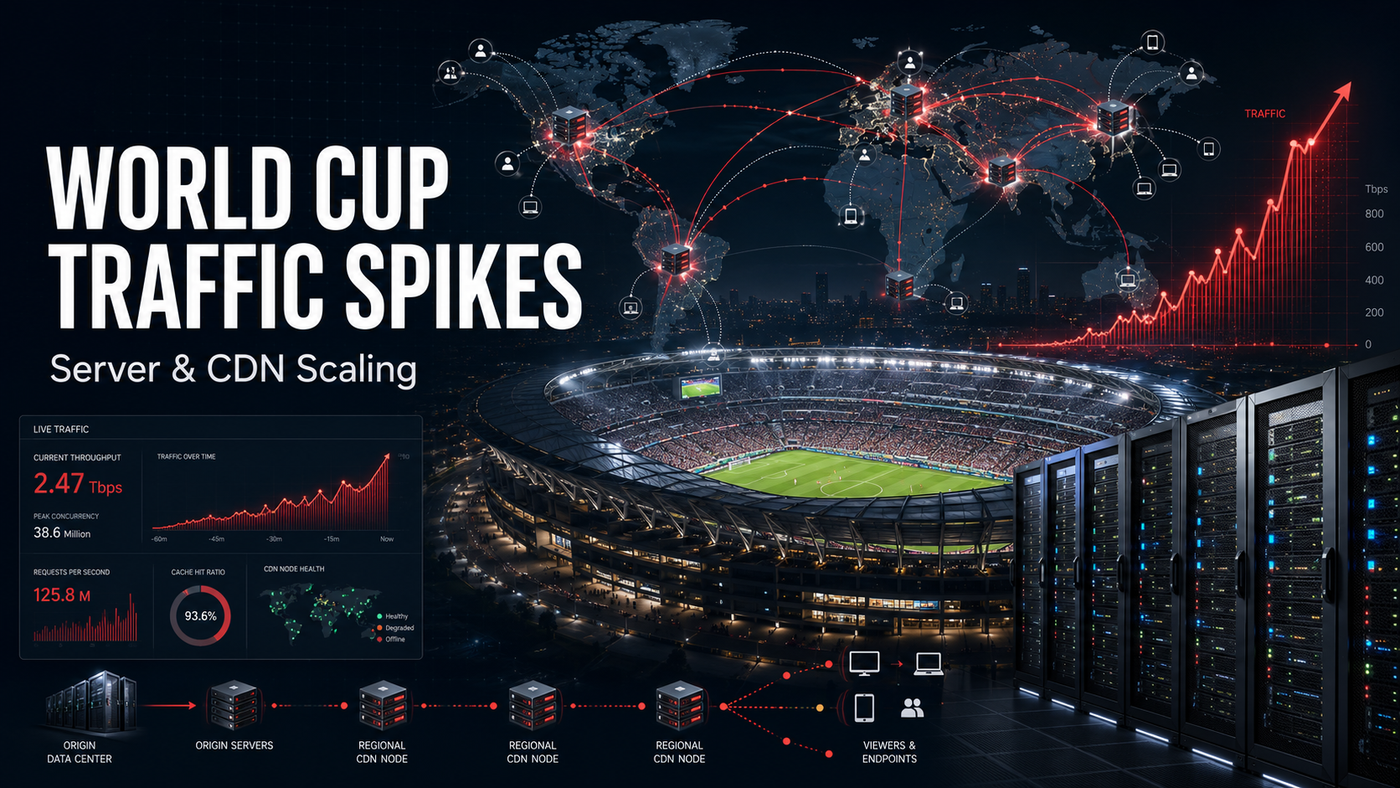
A World Cup match is not a normal traffic event. Millions of people press play in the same minute. A single goal can send concurrent viewers climbing sharply within seconds.
There is no fixing it after halftime. If the stream buffers during a penalty kick, the moment is gone, and so is the viewer's trust.
Broadcasters handle this by scaling every layer together, not just one. Multi-CDN delivery keeps any single network from becoming a bottleneck. Origin shielding stops spikes from hitting source servers directly. Backend systems survive sudden concurrent logins and entitlement checks. Security layers hold up under both real demand and malicious traffic.
This article breaks down how broadcasters and OTT platforms engineer for that load. It explains the server, CDN, and network decisions that keep a global stream watchable when millions of viewers show up at once.
Why the World Cup Breaks Normal Scaling Assumptions
Most video platforms are built around staggered demand. People watch a show whenever they want, so traffic smooths out over hours. Live sport removes that cushion entirely.
A World Cup match works like a global stress test. Millions of viewers arrive within seconds of kickoff, all requesting the same content at once.
Every goal, penalty, or contested VAR review can trigger a fresh spike, as fans reach for their phones, look for replays, or switch devices to keep watching.
That combination, a hard synchronized start, in-match spikes, and a global audience spread across every time zone and network type, is what separates sports streaming architecture from ordinary video delivery.
It Is Not Just Video: The Full Backend Under Load
Video delivery gets most of the attention, but it is often not the first thing to fail. A World Cup kickoff puts equal pressure on:
- Authentication and login systems, as millions of users try to sign in within the same short window.
- Entitlement checks, which confirm a viewer's subscription or region is valid before the stream starts.
- DRM and license servers, which issue playback licenses per session and cannot simply serve a cached response.
- App and platform APIs, powering menus, schedules, and the interface around the video player.
- Live stats and second-screen data, feeding real-time scores, lineups, and match graphics.
- Ad decisioning systems, choosing and inserting ads in real time for live streams.
- Analytics and monitoring pipelines, which need to keep reporting accurately even while everything else is under load.
These systems are dynamic. They generate a fresh, personalized response for every request, so they cannot be cached and pushed to the edge the way video segments can. That is a major reason backend scaling deserves as much planning as CDN scaling, not less.
The Pipeline: From Camera to Screen
Every live sports stream travels through the same stages, and each one needs its own scaling plan:
- Capture. Cameras at the venue produce high-bitrate feeds, often multiple angles plus graphics and commentary.
- Contribution. Feeds travel from the stadium to the cloud or broadcast center through engineered contribution paths, redundant fiber, managed routes, and backup systems.
- Encoding and transcoding. The source feed is compressed into an adaptive bitrate ladder for different devices and connections. This step needs its own reserved compute capacity, since it runs continuously for the length of the match.
- Packaging. Renditions are segmented into streaming formats, with DRM and encryption applied.
- Origin. A central set of origin servers holds the current segments and manifests that CDNs pull from, while DRM/license servers handle session-specific playback licenses.
- Delivery. A CDN, usually more than one, distributes segments from edge servers near viewers.
- Playback. The player requests segments and adapts quality to the network in real time.
A weak link at any stage shows up to the viewer as the same thing: a spinning buffer icon at the biggest moment of the match.
Origin Servers and Backend APIs Do Most of the Unseen Work
The CDN gets the credit, but the origin layer and backend APIs carry work the CDN cannot do on its own.
Origin Servers
Origin servers hold the source of truth for the live manifest and newest segments, while DRM/license servers handle session-specific playback licenses. Every CDN edge node ultimately depends on the origin staying fast and available, so origin infrastructure is usually built with its own redundancy, health checks, and failover targets, separate from the CDN layer.
Authentication And Entitlement APIs
Authentication and entitlement APIs have to verify who a viewer is and what they are allowed to watch, in real time, for every single session. This work does not compress well. A million viewers logging in around the same kickoff means a million individual checks, not one cached answer.
DRM and License Servers
DRM and license servers issue a playback license per viewing session. This is one of the most concurrency-sensitive parts of the whole stack, because it is nearly impossible to cache a security decision meant to be unique to each viewer.
Scaling these systems usually means running services horizontally behind load balancers, deploying regional instances closer to viewers, and load testing above the forecast peak, not just at the expected peak.
Multi-CDN: The Core of World Cup-Scale Delivery
Why One CDN Is Not Enough
Relying on a single CDN for a marquee event is a risk. If it degrades in one region, a chunk of the audience loses the stream at the worst possible moment.
In a multi-CDN setup, traffic is routed between two or more CDN providers based on real-time performance data, usually through DNS-based routing, client-side steering, or active switching.
The system weighs server health, latency, availability, and viewer location to decide which CDN performs best at a given moment, and shifts traffic away from any provider that starts to degrade.
| Routing Method | How It Decides | Best For |
|---|---|---|
| DNS-based load balancing | The resolver sends the viewer to a CDN based on geography, performance data, availability, or cost. | Broad geographic steering |
| Client-side / content steering | The video player queries a steering service and gets directed to the best-performing CDN. | Fast failover during playback |
| Active switching | The system automatically moves traffic to a better-performing CDN based on live performance rules. | Sudden regional degradation |
A Coverage Play, Not Just Redundancy
Different CDN providers have different regional strengths. One may perform better across the Americas, another across Europe or Asia. Combining providers extends coverage so performance holds up wherever fans are watching, which matters for a tournament with audiences spread across every continent at once.
What Can Actually Be Pre-Warmed Before Kickoff
Future segments of a live match cannot be cached before they exist. There is no way to pre-cache the next goal. What broadcasters can pre-warm ahead of kickoff are the assets that already exist: master manifests, initialization segments, pre-match slates, player assets, and other static or cacheable resources. This still matters because it means the first wave of viewers hits a warmed edge instead of an empty one, reducing the initial rush on the origin.
Failover testing matters as much as pre-warming. Before a major match, teams typically run health checks across every origin and CDN path, and rehearse traffic steering policies, so that if one path degrades mid-match, the switch to a backup path is a tested procedure rather than a live experiment.
Capacity Planning Goes Well Beyond CDN Bandwidth
Reservation windows for major events are not a formality, and they are not only about the CDN. Ahead of a tournament like this, capacity planning typically covers:
- Origin server capacity is sized for the specific matches expected to draw the largest audiences.
- Encoding and transcoding resources, since every additional bitrate rendition needs its own compute.
- DRM and license server capacity, tuned for concurrent session spikes rather than average load.
- App and backend API capacity, covering login, entitlement, and the interface layer around the player.
- Observability and monitoring tooling so that a problem shows up on a dashboard before it shows up as viewer complaints.
- Support and incident-response staffing, since a launch-day issue requires people ready to act, not just servers ready to scale.
Scrambling for any of this on match day is already too late. Reservation and rehearsal happen well ahead of the tournament.
Keeping Quality Smooth Under Load
Adaptive Bitrate Is the Safety Net
Instead of one fixed video quality, a stream is packaged as a ladder of resolutions and bitrates. Viewers move between Wi-Fi and mobile networks(4G and 5G), or hit temporary congestion mid-match, so the player needs to switch bitrates smoothly, not just deliver a sharp static image.
The result: instead of buffering outright, a viewer on a congested mobile connection quietly drops to a lower resolution and keeps watching. That trade-off, clarity for continuity, is deliberate.
Low Latency, as a Target Range, Not a Guarantee
Low latency matters more for live sport than for almost any other content, because fans may see a goal on social media or from a friend before their own stream catches up.
| Protocol | Typical Target Latency | Best Fit |
|---|---|---|
| Traditional HLS / DASH | 15 to 30+ seconds | Legacy device support and less time-sensitive content |
| LL-HLS / Low-Latency DASH | Roughly 2 to 5 seconds | Large-scale sports broadcasts |
| WebRTC | Sub-second | Interactive use cases like live betting, auctions, or real-time fan engagement |
These are practical target ranges, not guaranteed outcomes. Actual end-to-end latency depends on production workflow, encoding settings, packaging, CDN behavior, player buffer configuration, device type, and the viewer's own network quality. Hitting a sub-5-second target means tuning the whole pipeline, not just picking a protocol.
What This Looks Like for the 2026 Tournament Specifically
The 2026 FIFA World Cup is the first edition built around 48 teams, 104 matches, and 16 host cities split across three countries: the United States, Mexico, and Canada. That structural change multiplies the infrastructure challenge in a few concrete ways:
- More matches mean more peak windows. A 104-match tournament creates far more individual "kickoff moments" to plan capacity around than a smaller-format event.
- Three countries mean overlapping time zones. Matches hosted across the US, Mexico, and Canada span multiple time zones, which spreads peak local viewing hours differently for different regions and rights holders.
- More host cities mean more contribution points. Sixteen cities means sixteen separate venue-to-cloud contribution paths, each needing its own reliable first-mile connection.
- More rights holders mean more simultaneous demand on shared infrastructure. Broadcasters across dozens of countries often pull from the same global contribution feeds, multiplying the load on shared upstream infrastructure even when regional platforms are separate.
Reports from earlier tournaments give a sense of scale: FIFA has stated that the 2022 World Cup engaged several billion people worldwide across television, streaming, and digital platforms.
With a larger match count and format in 2026, platforms are planning for demand at least in that range, and likely higher, though exact comparative figures depend on how each platform measures reach.
Security Is Not an Afterthought
Traffic spikes and malicious traffic can look similar at the network layer, which is one reason security sits inside the same planning conversation as scaling, not off to the side. For an event this valuable, security infrastructure typically includes:
- DDoS mitigation at the network edge, to absorb volumetric attacks without affecting legitimate viewers.
- WAF and bot protection, filtering automated and malicious requests away from real traffic before they reach the origin.
- Signed URLs and tokenized access, so video segments and API responses cannot be freely reused or hotlinked outside the platform.
- DRM and encryption, protecting the video itself from unauthorized redistribution.
- Geo-restriction enforcement, matching content availability to the actual rights held in each region.
- Piracy monitoring, tracking unauthorized re-streams of the official feed, since these can also create unpredictable regional traffic spikes on top of legitimate demand.
- Origin protection, making sure none of the above traffic, malicious or not, ever reaches source infrastructure directly.
A tournament this valuable is also a target, both for unauthorized redistribution and for deliberate disruption. Edge-level security and origin protection sit alongside caching and load balancing as core requirements, not afterthoughts.
Frequently Asked Questions
Common questions about world cup traffic spikes: server & cdn scaling.
Can cloud autoscaling alone handle World Cup-level traffic?
What role do origin servers play in live streaming?
Why do streaming platforms sometimes crash before kickoff instead of during the match?
Why can't broadcasters just use one large CDN?
Does multi-CDN cost more than using a single provider?
Marc Serejo
Cloud Infrastructure Intern
I am a second-year engineering student currently working at RedSwitches, a cloud infrastructure company. My role involves hands-on experience with server systems and cloud environments, where I actively manage, monitor, and maintain servers to ensure reliability and performance. I work closely with clients to understand their technical requirements and handle server-related issues, including troubleshooting, maintenance, and support.

BeamMP Dedicated Server Setup Guide (2026)
Build and host a reliable BeamMP dedicated server on Windows or Linux with setup, configuration, optimization, security, and troubleshooting guidance.
ASKA Dedicated Server Setup Guide: 2026
Learn how to successfully install, configure, secure, and troubleshoot an ASKA dedicated server for smooth, persistent multiplayer hosting in 2026.

Wreckfest 2 Dedicated Server Setup Guide 2026
Build a reliable Wreckfest 2 dedicated server with clear, practical steps for 2026 covering installation, configuration, ports, optimization, and troubleshooting.
Power Your Next Project With Bare Metal
10 min delivery, zero setup fees, and 24/7/365 human engineers across 20+ global locations.