Top High-Frequency Trading Server Providers for 2026
In this guide, we’ll compare 2026 HFT server providers by latency, jitter, and exchange proximity, so you can choose venue-adjacent bare metal to help reduce slippage and improve fills.
High-frequency trading (HFT) turns tiny timing gaps into real outcomes. It uses algorithms to place and cancel large volumes of orders at machine speed. In this world, infrastructure decides what your strategy can actually capture.
Cut latency and you can improve queue position, reduce slippage, and stabilize fills. Leave latency unchecked, and even strong signals can arrive late.
Speed does not come from one upgrade. You get it from CPU clock consistency, low memory latency, clean Linux scheduling, and a network stack built to avoid avoidable overhead.
Many teams use kernel-bypass networking and, when it fits the pipeline, SmartNIC or FPGA acceleration. Location matters too.
Put your high-frequency trading servers near key colocation hubs like NY4, LD4, and TY3 to shorten the path to venues.
This guide breaks down the main infrastructure options and the build choices that matter in 2026.
Key Takeaways
- Every microsecond in HFT can impact execution quality, queue position, and profitability.
- CPU frequency, memory latency, and BIOS tuning drive consistent low latency.
- SmartNICs and FPGAs can reduce processing latency and jitter in feed-handling and order-entry pipelines.
- Colocation near NY4, LD4, and TY3 minimizes network delay.
- RedSwitches delivers full-control bare-metal servers you can tune for low jitter and consistent performance.
- BSO and Avelacom offer trading-focused low-latency connectivity across key global hubs.
- Beeks and Pico simplify scaling with managed HFT infrastructure and analytics.
- Options Technology supports regulated operations with managed governance.
- Interxion (Digital Realty) is a major European colocation and cross-connect ecosystem.
- AI-driven latency analytics and venue-adjacent edge deployments shape the future of HFT systems.
- The right trading infrastructure turns raw speed into lasting competitive advantage.
Top HFT Infrastructure Providers in 2026
| Provider | Key Features | When to Use |
|---|---|---|
| RedSwitches | Custom bare-metal, 1/10/25 Gbps uplink options, multi-region deployment, low-jitter tuning (site availability varies) | Full-control, tuned HFT setups |
| BSO | Low-latency fiber & microwave routes | Cross-market arbitrage |
| Beeks | Managed bare-metal + cloud, analytics | Scalable, easy setup |
| Options Technology | Connectivity + hosting for latency-sensitive trading, compliance-ready | Regulated trading firms |
| Pico | Full HFT stack + market data connectivity | Enterprise HFT environments |
| Avelacom | Global low-latency routes with service-level commitments (route- and contract-dependent) | Global latency advantage |
| Equinix | NY4/LD4/TY3 hubs, dense cross-connects | Exchange adjacency |
| Interxion | EU colocation, compliant & secure | EU-regulated traders |
Below are leading HFT infrastructure options used for low-latency execution across three buckets: colocation facilities, low-latency connectivity networks, and managed trading infrastructure.
Results depend on venue proximity, network path, and tuning. Each platform is tuned for real-world workloads, from institutional quant desks to independent FX traders who demand speed, precision, and uptime.
Win Microseconds With Bare Metal
Deploy tuned bare metal near exchanges, cut jitter, and benchmark routes fast. RedSwitches helps you optimize execution end-to-end.
1. RedSwitches
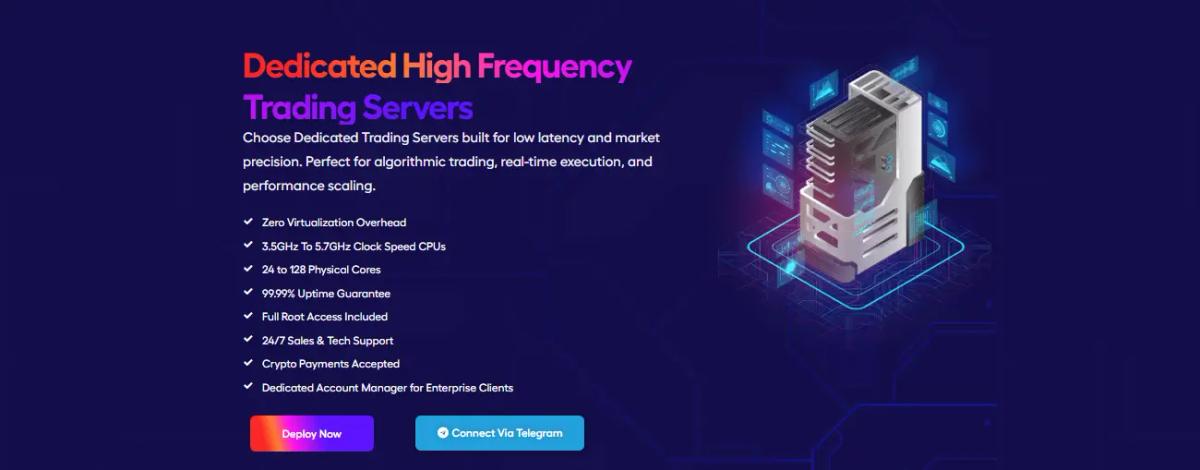
RedSwitchesoffers custom bare-metal servers for latency-sensitive trading across multiple regions; exchange-adjacent placement depends on the selected facility and location.
Features:
- Latest Intel and AMD CPUs. Models vary by plan. BIOS and OS tuning help reduce jitter.
- High-bandwidth uplinks with 1, 10, or 25 Gbps options. Routing depends on location.
- PCIe slots for advanced NICs and SmartNICs. Kernel-bypass support is available. FPGA needs are checked per build.
- Fast setup in many locations. Availability depends on the build. Crypto payments and 24/7 support are available.
- Dedicated bare-metal servers built for trading workloads.
- Full hardware isolation with no shared neighbors. Latency stays predictable under load.
- Support for low-latency tuning such as IRQ pinning, NUMA alignment, and CPU core isolation.
- Multi-region deployments so traders can place servers closer to exchanges, brokers, or liquidity venues.
Pros:
- Dedicated bare-metalyou can tune for low jitter.
- PCIe/NIC flexibility for kernel-bypass stacks (by build).
- Fast provisioning and 24/7 support (by location/build).
Cons:
- Custom build cost premium compared to standard hosts.
Ideal if you require deterministic performance, full control over your custom servers, and maximum proximity to major exchange infrastructure.
2. BSO
BSO specializes in ultra-low latency global connectivity routes tailored for high-frequency trading environments.
Features:
- Engineered low-latency microwave and fiber routes linking major financial hubs, with paths optimized per contract and region.
- Proprietary network design focused on minimizing hop count, jitter, and route asymmetry for trading traffic.
- Latency-SLA-backed connectivity services tailored specifically for capital markets workloads.
- Managed colocation and proximity hosting options integrated with BSO’s private network infrastructure.
- Route diversity and redundancy to reduce dependence on single-network paths for arbitrage strategies.
- Network monitoring and performance reporting are designed to track latency consistency rather than just uptime.
- Global coverage across key trading regions, supporting cross-venue and multi-market execution strategies.
Pros:
- Outstanding global route performance.
- Built for trading-specific connectivity rather than generic telecom.
Cons:
- Less direct hardware control compared to bare-metal providers.
Recommended for firms focusing on global arbitrage, spread capture across multiple markets where connectivity speed is the differentiator.
3. Beeks Financial Cloud
Beeks provides managed infrastructure for latency-sensitive trading. It combines bare-metal servers, virtualized options, and global colocation.
Features:
- Managed dedicated servers and virtual instances in major financial data centers and exchange-adjacent locations. Availability depends on region and contract.
- Built-in latency monitoring and real-time metrics to track execution paths and system behavior.
- Fully managed setup, so teams do not need to buy, rack, or maintain hardware.
- Infrastructure that scales from small quantitative teams to large institutional desks.
- Fast provisioning and easy expansion without long hardware lead times.
- Hybrid platform that supports both bare-metal and virtualized trading workloads.
- Centralized tools that simplify daily operations for low-latency trading systems.
Pros:
- Easy to deploy and scale.
- Built-in monitoring simplifies operations.
Cons:
- Less BIOS/firmware tuning flexibility compared to vendors specializing in custom hardware.
Perfect for trading teams who want low-latency capability without building full infrastructure themselves.
4. Options Technology
Options Technology provides enterprise-grade trading infrastructure with hosting, connectivity, and governance all bundled.
Features:
- Low-latency hosting and connectivity designed for capital markets workflows, including latency-sensitive order routing and governance needs.
- Integrated security controls, monitoring, and compliance tooling aligned with regulated trading environments.
- Managed infrastructure model covering deployment, maintenance, and lifecycle management of trading systems.
- Support for audit trails and operational visibility required by hedge funds and broker-dealers.
- Global presence across major financial data centers, enabling regional and cross-market trading operations.
- SLA-backed service delivery with defined performance, availability, and support commitments.
- Architecture designed to balance latency performance with governance, risk management, and operational resilience.
Pros:
- Strong compliance framework and managed service model.
- Well-suited for regulated hedge funds and broker-dealers.
Cons:
- Slightly less custom tunability in the hardware stack compared to specialist bare-metal players.
Optimal for trading operations where regulatory constraints, audit trails and managed risk matter as much as raw latency.
5. Pico

Pico offers comprehensive HFT ecosystems, from power and space to market feeds and analytics, across global exchange colocation sites.
Features:
- Exchange-integrated deployments across a broad set of global financial data centers, enabling proximity to major trading venues.
- Managed colocation services covering space, power, cooling, and physical infrastructure for trading systems.
- Private low-latency network fabric connecting Pico on-net sites to support cross-venue trading strategies.
- Market data services including feed capture, normalization, replay, and audit-friendly analytics.
- Centralized monitoring and performance visibility for infrastructure, network paths, and data flows.
- Operational support for global deployments, including coordinated provisioning and lifecycle management.
- Turnkey delivery model designed to simplify expansion into new markets without building local infrastructure from scratch.
Pros:
- Full service: you get infrastructure + connectivity + data-feed management.
- Excellent for global expansion.
Cons:
- Higher entry cost; best suited for larger-scale operations.
Ideal if you need a turnkey global HFT platform with managed infrastructure and global market access.
6. Avelacom

Avelacom specializes in low-latency connectivity designed for global trading across derivatives, FX, and crypto markets.
Features:
- Proprietary low-latency network infrastructure designed specifically for financial market connectivity.
- Dedicated high-speed routes with service levels defined by route and contract.
- Direct connectivity between major financial hubs and exchange locations.
- Network design focused on reducing latency swings and packet loss.
- Multiple routes and built-in redundancy to avoid single-path failures.
- 24/7 monitoring that tracks latency performance, not just uptime.
- Support for multi-asset trading strategies, including equities, derivatives, FX, and digital asset markets.
Pros:
- Excellent for cross-continent latency advantage.
- Strong fit for global arbitrage and multi-asset strategies.
Cons:
- Less focus on compute hardware; connectivity is the core offering.
Choose Avelacom if your strategy hinges on a global latency edge across far-flung markets rather than just a single venue.
7. Equinix
Equinix operates the critical HFT colocation hubs (e.g., NY4, LD4, TY3) that underpin many low-latency trading environments.
Features:
- Carrier-neutral colocation in major financial hubs such as NY4, LD4, and TY3.
- Close proximity to exchanges, brokers, and liquidity providers.
- Dense interconnection with many networks, cloud providers, and service partners.
- Private cross-connects for direct, low-latency communication.
- Metro interconnect and dark fiber options to reduce physical distance between systems.
- Redundant power, cooling, and security for high uptime and stability.
- On-demand connectivity provisioning to scale trading infrastructure quickly.
Pros:
- Exchange adjacency provides unmatched access.
- Ecosystem hosts many trading infrastructure providers.
Cons:
- Requires third-party compute or hosting provider; you manage hardware or lease from a partner.
Essential for any serious low-latency trader who wants proximity and access. It often forms the foundation of your HFT deployment.
8. Interxion (Digital Realty)

Interxion (Digital Realty) is a major European colocation and connectivity ecosystem. It is used by various trading firms. Official exchange colocation sites vary by venue and market.
Features:
- Carrier- and cloud-neutral colocation across Europe with no network lock-in.
- High interconnection density with access to many network providers and Internet exchanges on-site.
- Established financial services ecosystems that include traders, brokers, and market data providers.
- Standardized facility design with consistent power, security, and operational controls.
- Built-in redundancy across power, cooling, and connectivity for high availability.
- Global interconnection options through Digital Realty’s PlatformDIGITAL ecosystem.
Pros:
- Secure, compliant environment for EU-based or EU-regulated trading operations.
Cons:
- Primarily European focus; global coverage may require other partners.
Ideal for firms trading European markets under regulation (e.g., MiFID II) who need high-performance colocation inside the EU.
Core Hardware Architecture That Defines “HFT-Ready”
The backbone of every high-frequency trading server is its hardware design. Each component, from CPU cores to NIC firmware, directly influences execution speed. Below, we’ll break down the key architectural layers that make a server truly “HFT-ready.”
CPU and Memory
To achieve deterministic performance, every microsecond must be controlled and predictable.
- Use custom servers with high-clock CPUs (Intel Xeon / AMD EPYC).
- Enable BIOS tuning and NUMA pinning for thread isolation.
- Choose DDR5 ECC memory for stability under heavy compute loads.
- Lock CPU power states and frequency behavior. It reduces jitter (overclocking is optional and increases stability risk).
Network and SmartNICs
Your network stack decides how fast orders reach the exchange.
Low-latency network cards, such as NVIDIA/Mellanox ConnectX or Solarflare/Xilinx cards, work best with kernel-bypass networking.
FPGA and SmartNIC acceleration can skip parts of the operating system network stack. This reduces latency and jitter when handling market data and sending orders. Direct memory access still depends on your broker and exchange setup.
PTP-synced timestamping improves time accuracy and audit readiness. It does not change packet order or reduce network latency on its own.
Storage and OS / Firmware Tuning
Every I/O cycle affects trade consistency.
- Use NVMe drives and avoid swapping under load (size RAM correctly; keep swap minimal and monitor page faults).
- Apply isolcpus and tickless kernel for latency-focused scheduling.
- Disable deep C-states, tune turbo/governor behavior. Also evaluate SMT/Hyper-Threading based on jitter measurements.
- Maintain minimal background daemons for a clean Linux environment.
Time Synchronization and EU Compliance (EU Business Clock Rules)
Accurate time synchronization is critical for high-frequency trading systems. Under EU business clock requirements, firms must align reportable trading activity to Coordinated Universal Time (UTC).
For high-frequency trading systems, the maximum allowed drift from UTC is 100 microseconds.
In the EU, these requirements were updated via Commission Delegated Regulation (EU) 2025/1155 (applying from 2 March 2026), which keeps the 100 microsecond divergence requirement for HFT activity.
To achieve this precision, every component in your trading setup must trace its timestamps directly to UTC.
Key Compliance Elements
- PTP (Precision Time Protocol) Grandmasters: Distribute high-accuracy time across all trading nodes.
- GPS-Disciplined Clocks: Maintain UTC alignment even during signal or network disruptions.
- PTP-Aware Network Switches and NICs: Preserve timestamp accuracy through every packet transfer.
- Audit Trail Alignment: Ensure all order, quote, and event logs are UTC-traceable and verifiable.
- **Time-Synced Setups:**Use colocation close to exchanges and add GPS and PTP timing. This helps meet EU business clock accuracy rules.
Location, Colocation & Connectivity: Geography Is Latency
In high-frequency trading, geography decides speed. The closer your servers are to exchange data centers, the faster your trades execute.
Fiber adds roughly 5 microseconds of one-way delay per kilometer, so distance and routing add up fast. Physical placement and network design directly affect trading performance and profit.
Major HFT Hubs
- **NY4 (Secaucus, New Jersey):**A major colocation hub for U.S. equities, options, and FX connectivity.
- **LD4 (London/Slough):**A major colocation hub for European equities and derivatives connectivity.
- **TY3 (Tokyo):**A major colocation hub for Japan and broader APAC market connectivity.
- **HK1 (Hong Kong):**Key APAC colocation and financial connectivity hub.
Connectivity Methods
- Cross-Connects: Direct fiber links between servers within the same facility for microsecond-level communication.
- Microwave Links: Shorter, faster routes through air, ideal for inter-exchange arbitrage.
- Fiber Networks: Reliable for longer distances with predictable latency and redundancy.
Cost and ROI: When Ultra-Low Latency Pays Off
Ultra-low latency is expensive. But for active traders, the right balance between cost and performance drives profit. Small time gains matter.
Saving even microseconds can improve fills, reduce slippage, and increase trade accuracy. The key is matching infrastructure to your strategy and volume. Not every setup needs the lowest possible latency.
Latency vs Cost Snapshot
| Setup Type | Typical Latency (venue/path dependent) | Cost Range (Monthly) | When to Use |
|---|---|---|---|
| VPS | 1–10 ms | $50–$200 | Testing, small-scale FX or crypto trading |
| Dedicated Server | sub-ms to low-ms (same metro/colo) | $400–$1200 | Professional low-latency trading |
| FPGA System | processing can be <100 µs; end-to-end varies | $3000+ | Institutional HFT, market making |
ROI Insights
- Reducing latency can improve queue position, fill probability, and slippage. But the ROI is strategy- and venue-dependent.
- Measure impact using slippage, fill ratio, reject rates, and queue position before scaling spend.
- The HFT server price should be justified by measurable trading outcomes, not just theoretical speed.
Emerging Trends and Future-Proofing Your HFT Stack
High-frequency trading is entering a new phase. Speed still matters, but intelligence and flexibility matter just as much.
To keep infrastructure ready for the future, trading firms need to watch four key trends. These trends are reshaping the high-frequency trading software and platforms.
FPGA and SmartNIC Integration
- Hardware acceleration moves trade execution logic closer to the network layer.
- FPGA and SmartNIC cards process market data and execute orders within microseconds.
- Future-ready custom servers must support FPGA/SmartNIC modules for deterministic latency and kernel bypass.
AI-Enhanced Latency Prediction
- Machine learning models predict network congestion and microbursts before they affect execution.
- AI-driven routing dynamically reroutes orders to minimize delay.
- Building telemetry pipelines today enables faster adoption of predictive latency control.
Venue-adjacent Edge Deployments
- Edge colocation reduces the physical distance to exchanges.
- Venue-adjacent deployments and private connectivity can shorten paths for regional venues.
- Ideal for firms expanding into new regions or testing ultra-local strategies.
Security and Compliance Automation
- SmartNICs can offload some network and security tasks. You still need to test how they affect latency and jitter in your setup.
- Automated compliance tools help meet EU business clock rules and audit-trail requirements. They do this without slowing down execution.
- Choose infrastructure that supports real-time monitoring.
- Policy updates should happen at the network edge, not later in the stack.
The future of HFT depends on flexible, low-latency systems. FPGA acceleration, AI-driven analytics, edge computing, and automated compliance work best when combined. Together, they help keep trading systems fast, stable, and competitive.
Conclusion
In high-frequency trading, every microsecond matters. Profit or loss depends on how fast your servers act, how close they are to exchanges, and how accurately they process data. The right infrastructure means faster trades, steady fills, and fewer missed chances.
Optimized HFT servers give you stable performance and reliability you can count on. They form the base every trader needs to stay ahead in 2026’s fast markets.
Benchmark your latency with RedSwitches and see how better infrastructure gives you the edge.
FAQs
Q. Can I use a VPS for HFT?
You can, but it’s not ideal. VPS servers share resources, which adds delay. For true low-latency trading, a dedicated or bare-metal server performs better.
Q. What is the best CPU for HFT in 2026?
High clock speed and low memory latency matter most. Choose the newest Intel Xeon or AMD EPYC platform available in your venue region and tune it for low jitter.
Q. Do overclocked servers help or hurt consistency?
Overclocking can lower latency but may cause instability. Most traders prefer tuned, stable systems instead of pushing maximum clocks.
Q. How much does an HFT server cost?
Entry setups start near $400 per month. Advanced FPGA or SmartNIC-based systems can cost over $3,000 monthly.
Q. How often should firmware be tuned?
Check and tune firmware with every major market or kernel update, about every 3 to 6 months for most setups.
Hafsa Qadeer
Technical Writer
Hafsa Qadeer is a Technical Content Writer at RedSwitches and a journalist with a background in molecular biology and oncology. She brings research precision to technical writing and SEO strategy, turning complex topics in infrastructure, biotech, and AI into content that informs and engages.

BeamMP Dedicated Server Setup Guide (2026)
Build and host a reliable BeamMP dedicated server on Windows or Linux with setup, configuration, optimization, security, and troubleshooting guidance.

ASKA Dedicated Server Setup Guide: 2026
Learn how to successfully install, configure, secure, and troubleshoot an ASKA dedicated server for smooth, persistent multiplayer hosting in 2026.

Wreckfest 2 Dedicated Server Setup Guide 2026
Build a reliable Wreckfest 2 dedicated server with clear, practical steps for 2026 covering installation, configuration, ports, optimization, and troubleshooting.
Power Your Next Project With Bare Metal
10 min delivery, zero setup fees, and 24/7/365 human engineers across 20+ global locations.