Best iGaming Server Hosting Providers 2026
Choosing the right iGaming provider for your casino or sportsbook can decide whether players stay or never come back. Real-money games need more than generic gaming hosting services.
iGaming needs dedicated servers that stay online during peak matches, clear latency targets, and security that can handle constant attacks.
Many serious operators run core workloads on bare metal or hybrid stacks, not shared hosting. This guide walks you through the top dedicated server companies for iGaming and shows where each one fits.
You will see who leads for performance, who focuses on licences, and who gives you the most power for the money. By the end, you will know exactly which provider shortlists to build.
Key Takeaways
- Real-money iGaming needs dedicated servers, low latency, and always-on security.
- Shared hosting often fails under peak traffic. VPS can work for small launches, but isolation stays limited.
- Start with 3–6 dedicated servers and scale fast.
- Shortlist: RedSwitches (best overall), NovoServe (EU), Leaseweb, Servers.com (sportsbooks), INNETRA (Amsterdam; licence-aligned), LeasePacket (budget).
- Dedicated hosting gives full machine control, isolation, and predictable CPU and I/O.
- Keep detailed logs for audits and regulator checks.
- Launch shape: 1–2 web/API nodes, 1–2 game/engine nodes, 1 NVMe database (+1 standby if possible).
- RedSwitches accepts crypto and suits Web3 stacks.
- Ask about DDoS: always-on, capacity, L3–L7 coverage, scrubbing latency, included events, and attack reports.
Top iGaming Hosting Providers
You do not pick these vendors for hobby projects. You pick them when every second of uptime, every millisecond of latency, and every audit trail can cost or earn real money.
The providers below all build on dedicated servers and high-capacity networks, but each one solves a slightly different problem, from Web3-heavy stacks to EU-only platforms.
| Provider | Best For | Key Regions | Highlights | Compliance / Security |
|---|---|---|---|---|
| RedSwitches | Best overall; Web3 + iGaming | NA/EU/APAC (20+ DCs) | AMD EPYC/Ryzen/Intel Xeon, NVMe, 1 Gbps, 10 Gbps & 25 Gbps, unmetered options, crypto payments, fast setup | DDoS, 24/7 support |
| Leaseweb | Hybrid iGaming stacks (dedicated + cloud/CDN) | Global (EU/NA/APAC | Low-latency network, 99.999% core uptime (claim) | ISO 27001/PCI DSS (varies), Tier III+, DDoS IP Protection (≤5Gbps; 2–3 min) |
| NovoServe | EU bare metal, low latency | Netherlands + wider EU (US: New York) | High-freq CPUs, NVMe, network tuned for low jitter | ISO 27001 DCs, strong DDoS |
| Servers.com | Sportsbooks & esports | EU/US/Asia (25+ DCs) | Dell bare metal, NVMe, private networking/GPN | DDoS options, global private network |
| INNETRA | Licence-tied dedicated hosting | Curaçao, Malta, Cyprus | Unmetered bandwidth plans, RNG hardware support | Tier III, ISO 27001, PCI DSS |
| LeasePacket | Budget dedicated growth | EU/US (by plan) | Modern Intel, 32–128 GB RAM, NVMe, 10–25 Gbps, free migration | 99.9% uptime, monitoring, firewalls |
***Important:***All specifications, SLAs, and pricing are taken from provider sites and sales sheets. These are subject to change as services evolve. Always validate the latest terms with the provider.
RedSwitches
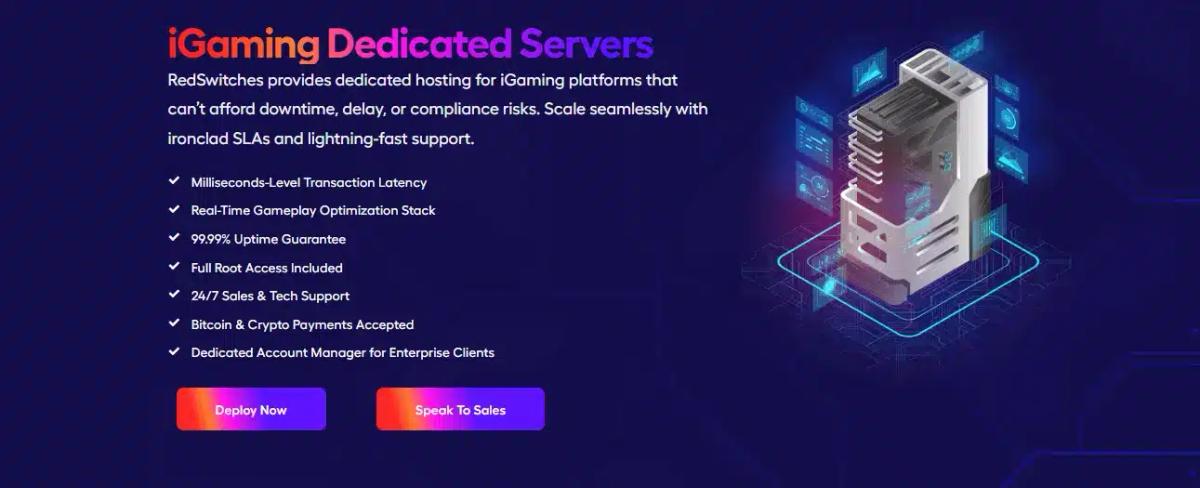
RedSwitches iGaming Dedicated servers sit at the sweet spot where raw metal, bandwidth, and Web3 hosting meet.
Our platform focuses on high-performance bare metalwith fast delivery, so your team can move from idea to live traffic without long lead times.
If you run a crypto casino, a Web3 betting product, or a high-traffic platform that needs serious horsepower, this is the first name to test.
Who it suits
- Crypto casinos and Web3 betting projects.
- Game studios and B2B platforms.
- Operators that want strong hardware at sharp pricing.
Key strengths
- Wide AMD EPYC/Ryzen and Intel Xeon range with SSD and NVMe options.
- 20+ global data centers on a high-capacity network.
- 1Gbps, 10Gbps & 25Gbps ports, plus unmetered bandwidth plans. Web3 and node hosting focus withcrypto payments.
- 24/7 support and quick provisioning on many configs.
Best use cases
- Core stack for crypto iGaming and on-chain games.
- Game servers and APIs for B2B platforms.
- Analytics, streaming, and side services in hybrid regulated setups.
Leaseweb

Leaseweb targets iGaming platforms that need speed, uptime, and a clean hybrid design. Their iGaming page focuses on dedicated servers for raw compute, then layers cloud, CDN, and security services when your traffic swings hard.
Who it suits
- Online casinos, sportsbooks, and iGaming platforms with global player bases
- Teams that want a hybrid stack, not just a single server
- Operators that need strong network uptime claims and scalable capacity planning.
Key strengths
- High-performance dedicated servers designed for fast gameplay and transaction flows.
- Hybrid design options that can combine dedicated servers, cloud, CDN, and cybersecurity services.
- Global presence across four continents and a stated 99.999% core network uptime.
- Dedicated server security posture that includes standard DDoS IP Protection and Tier III (minimum) data center hosting.
- Compliance and assurance coverage published across ISO 27001, PCI DSS, SOC reports, and more.
Best use cases
- Multi-region iGaming platforms that need consistent performance across markets.
- Hybrid deployments where web, APIs, and content sit behind CDN, while databases and bet engines stay on dedicated servers.
- Operators that want infrastructure components (servers, cloud, CDN, security) under one vendor relationship.
NovoServe

NovoServe builds dedicated iGaming servers with a clear focus on latency, uptime, and compliance for European and global operators.
Their iGaming page is explicit: bare metal tuned for casinos, sportsbooks, game studios, and payment providers.
If you care about EU routing, low jitter, and a network that handles match-day spikes.
Who it suits
- EU iGaming operators and platforms.
- Brands that need low latency inside Europe.
Key strengths
- Dedicated iGaming server line with clear bare-metal specs.
- High-frequency CPUs with SSD or NVMe for fast responses.
- ISO 27001 data centers with strong DDoS protection.
- Network tuned for low-latency, high-throughput traffic and high core uptime.
- 24/7 support with fast reaction to incidents.
Best use cases
- European live betting platforms.
- Core game servers and APIs for EU casino brands.
- Payment, KYC, and risk services that serve many EU brands.
Servers.com
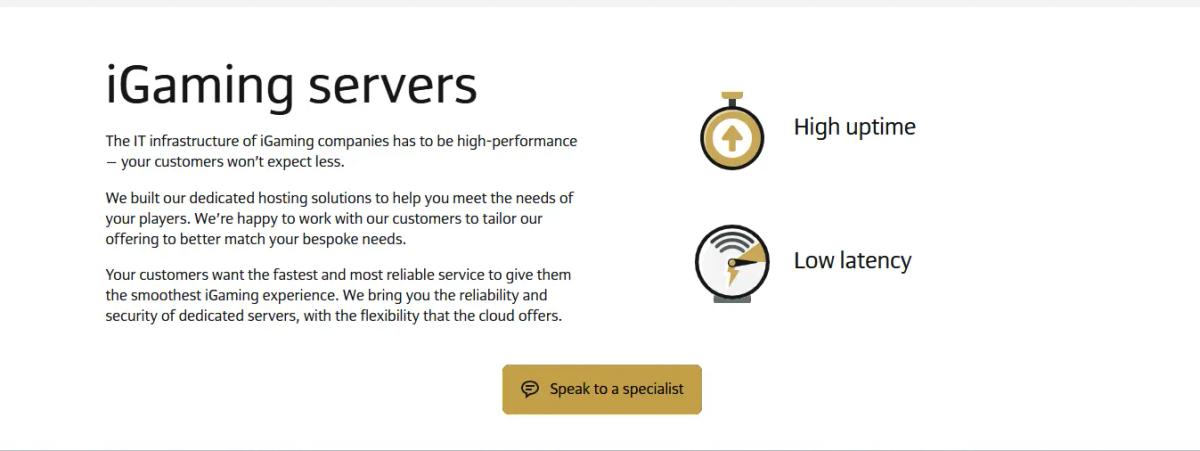
Servers.com builds dedicated iGaming servers for teams that care about both speed and custom hardware.
They run single-tenant Dell PowerEdge bare metal in 25+ data centers and design iGaming stacks around odds feeds, trading engines, and real-time betting flows.
Their iGaming teams help you plan capacity for launches, major events, and ongoing seasons, so you are not guessing when traffic spikes.
Who it suits
- Sports and esports bookmakers that run live odds and in-play betting.
- Tech teams that want custom hardware, routing, and private networking.
Key strengths
- Dedicated iGaming solutions on bare metal with SSD or NVMe for fast read and write.
- Private networking, a free global private network (GPN), and DDoS options for internal APIs and secure links.
- Wide data center spread across Europe, North America, and Asia, which helps you place trading stacks close to markets.
- Flexible server specs for CPU-heavy trading or I/O-heavy bet logging, with many configs ready in about 40 minutes.
- 24/7 support with fast response times (confirm SLA terms in your contract).
Best use cases
- Odds feeds, trading engines, and pricing models that need stable latency.
- Real-time bet placement, cash-out, and settlement for sports and esports.
- Mixed gaming and non-gaming workloads that still demand bare metal and global reach.
INNETRA
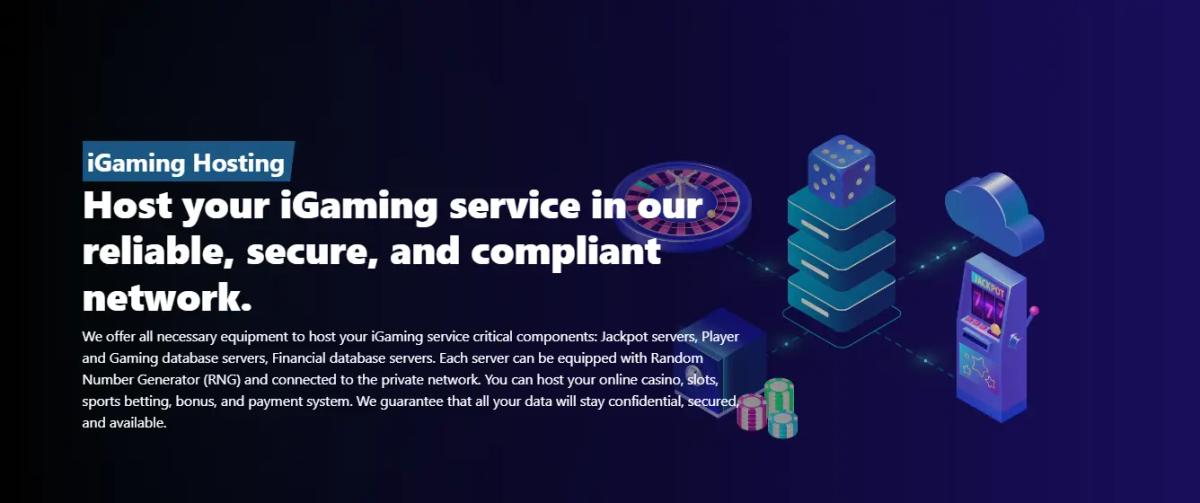
INNETRA builds iGaming hosting around dedicated servers that match the demands of CIGA in Curaçao, the Malta Gaming Authority, and the Cyprus National Betting Authority.
Their iGaming page calls out jackpot, player, and financial database servers as first-class parts of the stack, all placed in ISO 27001 and PCI DSS certified Tier III data centers.
That mix makes INNETRA a strong fit when you want hardware and network design that mirrors licence conditions.
Who it suits
- Curaçao projects that need hosting aligned with CIGA requirements.
- MGA and Cyprus NBA licence holders and applicants who want a clear match between hosting and regulator documents.
Key strengths
- iGaming hosting page based only on dedicated servers with entry, mid, and high-end plans for casino and sportsbook loads.
- Unmetered and unshared bandwidth with always-on DDoS protection and a scrubbing network above 1 Tbps.
- Tier III data centers with ISO 27001 and PCI DSS, which suits payment flows and player funds.
- Pluggable hardware RNG support, which helps pass technical certification in some licence regimes.
- Custom dedicated configs on request if the standard plans do not match your workload.
Best use cases
- Curaçao-licensed casinos and sportsbooks that want CIGA-compliant hosting and strong DDoS cover.
- MGA or Cyprus NBA licence projects that need jackpot, player, and financial databases in certified Tier III facilities.
- Mixed stacks where INNETRA hosts “critical components”, while another provider handles content, marketing sites, and lighter services.
LeasePacket
LeasePacket focuses on affordable dedicated servers with enough power for real workloads. Their iGaming hosting page leans on price–performance and free migration, so smaller teams can move off crowded VPS or shared plans without blowing the budget.
If you want bare metal, but every dollar still matters, LeasePacket is a practical starting point.
Who it suits
- New casino or sportsbook projects moving from shared or cloud plans.
- Startups that need predictable monthly spend on dedicated hardware.
Key strengths
- iGaming hosting page built around affordable dedicated servers and free migration.
- Solid entry and mid-range configs with modern Intel CPUs, 32–128 GB RAM, and NVMe storage.
- 10 Gbps ports on many offers, with mention of ports up to 25 Gbps for higher tiers.
- 99.9% network uptime, 24/7 support, firewalls, and real-time monitoring are included in most plans.
Best use cases
- First production stack for a new casino or sportsbook that wants dedicated resources from day one.
- Extra capacity for promos, tournaments, or seasonal traffic spikes without long-term lock-in.
What “Dedicated iGaming Hosting” Really Means
Dedicated iGaming hosting is not just “more powerful game hosting”. It is an infrastructure stack built around real money, licences, and player funds.
You run wallets, payment flows, risk checks, and jackpots alongside game logic, all under the scrutiny of regulators and auditors. That mix needs guaranteed resources, strict access control, and clear evidence of what happened on every box.
With dedicated servers, you control the full machine. No noisy neighbours, no surprise CPU throttling, and no mystery processes from other tenants.
You decide how to harden the OS, where to store logs, and how to separate wallets, RNGs, and web frontends. That level of control is the base layer for any serious iGaming platform.
Dedicated Servers vs Generic Gaming Hosting Services
| Area | Generic Gaming Hosting (FPS/Survival/Casual) | Dedicated iGaming Hosting (Casino/Sportsbook) |
|---|---|---|
| Primary goal | Keep ping low and player slots online | Keep wallets, bets, and sessions reliable under load |
| Typical architecture | Many small instances packed on shared or semi-dedicated nodes | Single-tenant servers built for core real-money services |
| Data handled | Game state, chat, basic player data | Money flows, KYC data, card payments, full player histories |
| Regulatory pressure | Low | High (Malta, Curaçao, US states, other markets) |
| Stack components | Game server + basic control panel | Wallets, game servers, bet engines, risk tools, back office, logs |
| Isolation | Limited; other tenants can impact performance | Strong; your machine runs only your workloads |
| CPU & I/O predictability | Variable; noisy neighbors and throttling risk | Stable; consistent core speed and disk performance |
| Log + data control | Basic logging, limited retention controls | Full control over log storage, retention, and access for audits |
| Risk tolerance | Fine for hobby communities | Not acceptable for real-money wagering |
Why Serious Operators Move to Dedicated iGaming Servers
As brands grow, incidents on shared or generic setups start to hurt. Live odds freeze for a few seconds. A bonus campaign brings down a whole node.
Support blames “other customers on the same host”. At that stage, mature operators move to dedicated iGaming servers and treat hardware as part of their risk stack, not just a cost line.
Dedicated boxes give you consistent performance for live betting and live casino. You can tune kernel settings, network buffers, and caching for your own pattern of bets and spins.
When a match kicks off or a jackpot drops, the platform keeps its shape because no one else competes for the same cores.
They also give you a clear path for audits and compliance. You know which machine handled which game session, which wallet change, and which payout.
You can map components to datacenters, show certifications, and hand over structured logs when a regulator asks for details.
During incidents, dedicated hosting makes root cause analysis far easier. You can trace issues down to a service, a config, or a disk without guessing what another tenant did.
That speed reduces downtime and helps your team build a track record of fast, clean recoveries that regulators and partners trust.
Feature Checklist for Dedicated iGaming Server Providers
Use this checklist to judge any host on your shortlist. If one of these areas looks weak, you should dig deeper or walk away.
Regulatory and Data Residency
- Confirm which country and city each core server sits in.
- Check if the data center meets ISO 27001 and, where needed, PCI DSS or similar standards.
- Ask where backups and logs live and how long the provider keeps them.
- Verify whether the host has experience with your regulator, not just “gaming” in general.
Hardware and Performance
- Note the CPU class and generation, not just “Intel” or “AMD”.
- Check RAM range and growth options for busy periods.
- Look for NVMe storage or SSD in RAID for key databases and logs.
- Confirm port speeds for each plan and how they change with upgrades.
Network and Routing
- Ask which carriers and peering partners the provider uses in each region.
- Check how many POPs they run and where they sit relative to your players.
- Run simple latency tests from key markets to their suggested data centers.
- Confirm how the provider handles routing during DDoS or routing failures.
Security and DDoS
- Make sure always-on DDoS protection is part of the base offer, not a tiny add-on.
- Ask about WAF, intrusion detection, and log collection across all layers.
- Check who watches alerts and how they escalate major events.
- Request a sample incident report to see the level of detail you would get.
Support and SLAs
- Confirm response times for critical, high, and normal tickets.
- Ask how fast they replace faulty hardware or move you to a new node.
- Check the uptime target, the time window, and how they define “downtime”.
- Make sure the SLA lists real credits or penalties, not vague promises.
Contracts and Pricing Clarity
- Break down the monthly base price by server, bandwidth, and add-ons.
- Ask for clear rates on bandwidth overages and DDoS bursts.
- Check terms for upgrades, downgrades, and extra nodes mid-contract.
- Read exit clauses and migration support so you know how hard it is to move later.
Final Verdict
Dedicated iGaming hosting is not a luxury. It is the only way to keep wallets, bets, and player sessions safe while traffic jumps and regulators watch. You now know how to read specs, spot weak offers, and match each host to a real use case.
The smart move is to mix a compliance-friendly iGaming provider with a high-performance bare metal partner that handles heavy loads, Web3, and future features.
When you look at your shortlist through that lens, one or two vendors will stand out as the natural core for your next build.
If you want that “core” layer to stay simple, strong NVMe, low latency, high bandwidth, and support that responds, RedSwitches is a solid place to start your testing and capacity planning.
FAQs
Q. What is considered iGaming?
iGaming covers any real-money gambling activity that happens online. That includes sports betting, casino games, live dealer tables, poker, bingo, lotteries, fantasy sports, and skill games when they use real cash or tokens with value. If players can deposit, wager, and withdraw, it falls under iGaming and sits under gambling laws, not just “gaming” rules.
Q. How does iGaming work?
An iGaming platform connects several moving parts. Players sign up, pass KYC checks, and fund a wallet. The platform serves games from its own servers or from third-party studios over APIs. A bet engine records stakes, calculates outcomes, and settles wins based on game results or live data feeds. Payment processors handle deposits and withdrawals. Risk and compliance tools watch for fraud, self-exclusion, AML flags, and bonus abuse. All of this runs on hosting designed to keep latency low and records accurate.
Q. What is an iGaming provider?
An iGaming provider is a business that supplies core pieces of this stack. That can be a platform vendor, a game studio, or a specialist host. In this context, a hosting-focused iGaming provider offers dedicated servers, network, security, and support tuned for real-money games. They understand licence rules, data residency demands, and the need for detailed logs. They do not run the casino for you. They run the infrastructure that keeps it online and fast.
Q. How many servers do I need for a small iGaming launch?
For a first launch, most teams start with 3–6 dedicated servers and grow from there:
- 1–2 servers for web frontends and APIs.
- 1–2 servers for game logic, bet processing, and internal services.
- 1 database server with NVMe and strong backups, plus 1 standby if budget allows.
If you add live casino, heavy streaming, or many partner brands, you will outgrow this quickly. Plan your launch on the low side, then keep budget and IP space ready for more nodes once you see real traffic patterns.
Q. Which dedicated hosts accept crypto payments?
**RedSwitches –**accepts crypto payments and supports Web3/node workloads. Other hosts may accept crypto through third-party gateways, but they do not push it as a key feature. Always check billing terms and refund rules before you commit.
Q. What should I ask about DDoS before I sign a contract?
Ask direct, detailed questions, such as:
- Is DDoS protection always on, or only “on demand”?
- What size of attack can you absorb in Gbps and Mpps?
- Do you filter at both the network and application layers?
- Where are your scrubbing centers located, and what additional latency do they introduce?
- How many DDoS events are included in the base price, and when do additional fees apply?
- Will I get full attack reports with timestamps, targets, and mitigations for audits?
If a provider cannot answer these in clear, simple terms, they are not ready for serious iGaming traffic.
Fatima J.
Technical Writer
Fatima is a writer who has authored a wide range of technical guides for the RedSwitches blog, covering Linux, servers, and hosting topics, with a focus on making hands-on subjects clear and approachable.

Aloft Dedicated Server Setup Guide 2026
An Aloft world can grow quickly when your crew is building, exploring, and sailing between floating islands together. But when the player hosting the session leaves, everyone may lose access to that shared world until the host returns.
The Front Dedicated Server Setup: Windows, Linux, Ports and Fixes
Your The Front dedicated server can launch successfully while your friends still cannot join. The real test is a world that players can reach, and return to without losing progress.
Subnautica Dedicated Server Setup (2026): Nitrox 1.8.1 Guide
Your group has a base to finish and deeper waters to explore, but the next session depends on someone keeping the server online. Can a Subnautica dedicated server give everyone access without that player staying in the game?
Power Your Next Project With Bare Metal
10 min delivery, zero setup fees, and 24/7/365 human engineers across 20+ global locations.