Top 10 AdTech & MarTech Hosting Solutions (2026)
This guide ranks 10 AdTech and MarTech hosting solutions for RTB, CDPs, and analytics, covering bare metal, Kafka streaming, CDNs, security, and cost control.
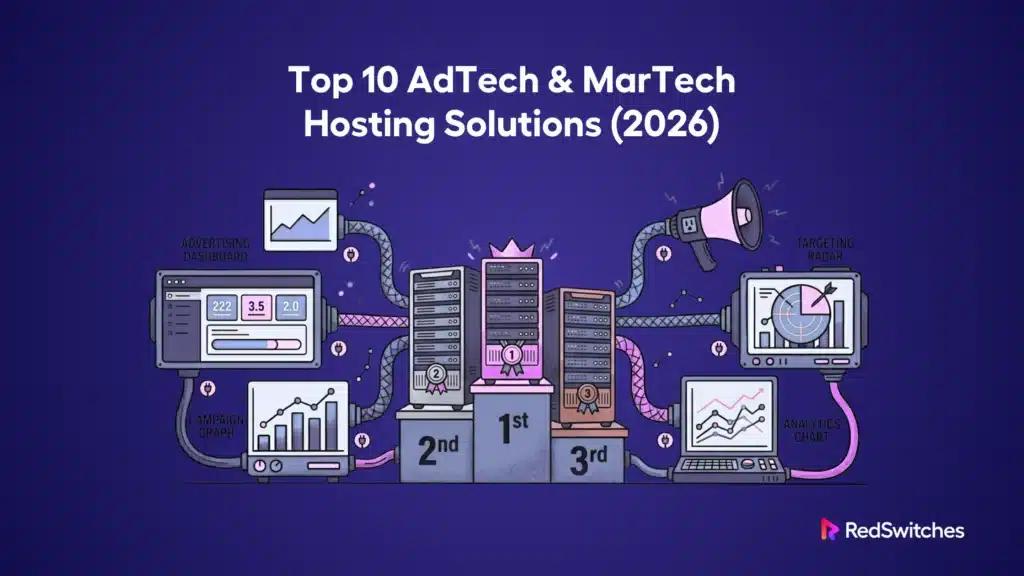
AdTech (advertising technology) and MarTech (marketing technology) power how brands reach and understand customers. These two worlds now overlap, driven by automation, personalization, and real-time data.
That convergence puts hosting at the center of performance. Slow infrastructure means missed bids, delayed insights, and wasted spend. In real-time bidding (RTB), even a few milliseconds can matter; in CDPs, “real-time” varies by workflow (some are streaming, many are batch).
High uptime, fast networks, and global reach keep every campaign running smoothly. The right hosting isn’t just support, it’s a strategy.
In this guide, we’ll explore the top 10 hosting solutions built to handle modern AdTech and MarTech demands: fast, secure, and ready to scale.
Key Takeaways
- AdTech and MarTech have converged into a unified, data-driven marketing engine that demands specialized infrastructure.
- Millisecond-level latency directly impacts revenue in real-time bidding (RTB) and real-time decisioning; CDP workflows vary from near-real-time to batch.
- Bare-metal servers deliver superior performance-per-dollar for consistent, high-volume AdTech workloads.
- RTB performance is constrained by exchange timeouts (OpenRTB tmax).
- Network distance (where your bidder runs) directly affects whether you can respond in time.
- Many teams target sub-100ms internal processing, but tmax varies widely, from tens of milliseconds to over a second, depending on exchange and placement.
- Enterprise-grade security with DDoS mitigation and bot protection is essential to prevent budget waste and maintain trust.
- GDPR and CCPA compliance depend on strong data governance and operational processes; regional controls and privacy-safe measurement tools (like clean rooms) can help but aren’t mandatory.
- Scalable architecture must allow ingestion, processing, and analytics layers to expand independently during traffic spikes.
- Large edge networks with broad global coverage reduce latency and improve ad delivery performance worldwide.
- Total cost of ownership matters more than headline pricing; cloud egress fees can quickly exceed dedicated server costs.
- Infrastructure selection should align with specific needs: dedicated servers for RTB, managed Kafka for event streams, and CDNs for global delivery.
Top 10 AdTech & MarTech Hosting Solutions in 2026
This list includes bare-metal hosting, edge/CDN layers, and managed data/streaming platforms, because modern AdTech/MarTech performance depends on the full pipeline, not just compute.
| Provider | Core Strength | Highlights | Ideal Use | |
|---|---|---|---|---|
| 1 | RedSwitches | Bare-metal speed | 10Gbps & 25Gbps unmetered (plan/location dependent), NVMe + ECC RAM, 24/7 support | RTB, CDP, analytics pipelines |
| 2 | Snowflake | Privacy-safe collaboration | Clean Rooms, cross-cloud data sharing | Partner analytics, data privacy |
| 3 | Databricks | Unified data + AI | Lakehouse, streaming + batch ML | LTV modeling, personalization |
| 4 | ClickHouse | Real-time analytics | ms-level OLAP, Kafka integration | Live dashboards, A/B tracking |
| 5 | Confluent Cloud | Event streaming | Managed Kafka, global scale | Bidstreams, fraud detection |
| 6 | Cloudflare | Edge delivery + security | 300+ cities, DDoS / Bot protection | Global ads, secure APIs |
| 7 | Fastly | Instant CDN + visibility | Real-time logs, edge compute | OTT / CTV, dynamic creatives |
| 8 | Yospace | SSAI for CTV/live ads | Sub-5s latency, frame-accurate stitching | Broadcasters, CTV monetization |
| 9 | Google Cloud | Marketing ecosystem | BigQuery, Ads Data Hub, GA4 | GA4 / Ads integration |
| 10 | Leaseweb | Managed bare metal | Global DCs, fixed pricing | Ad exchanges, DSP workloads |
Your stack lives or dies on speed, uptime, and trustworthy data paths. These are the platforms we trust for RTB, CDPs, and analytics at scale.
Note*: This guide reflects RedSwitches’ infrastructure viewpoint, based on latency, uptime, security, and cost predictability for AdTech/MarTech stacks that run on dedicated bare metal.*
1. RedSwitches
When every millisecond affects bids and revenue, bare metal wins. RedSwitchesdelivers raw throughput, tight latency, and full control for RTB, CDP, and real-time analytics.
Features
- 10Gbps and 25Gbps unmetered dedicated bandwidth (plan/location dependent) and ultra-low-latency network options.
- NVMe storage, ECC RAM, full root/IPMI; stream-ready for Kafka/Flink.
- 24/7 expert support, free migrations, and crypto payments accepted.
Pricing
- Flat monthly per server; price varies by CPU/RAM/NVMe/port speed; unmetered packagesavailable.
When to use
- High-QPS bidders, DMP/CDP pipelines, and analytics collectors that need predictable low latency and cost control.
Stop Losing Auctions To Lag
Run your bidder and event pipeline on dedicated bare metal built for real-time traffic. Lower latency, stable performance, and security controls that protect ad spend.
2. Snowflake AI Data Cloud

Share audience insights with partners without exposing raw PII. Snowflake’s clean rooms make collaboration safe and compliant.
Features
- Data Clean Rooms with governance for audience overlap, lift, and measurement.
- Cross-cloud sharing (AWS/Azure/GCP) and global collaboration; widely adopted for governed data sharing and clean room workflows.
Pricing
- Usage-based: compute credits + storage + data transfer; pause/resume warehouses to control spend.
When to use
- Privacy-first partner analytics, incrementality studies, and multi-brand data sharing under strict compliance.
3. Databricks Lakehouse
One platform for clickstreams, CRM, creative metadata, and ML. Databricks unifies data and AI for LTV, attribution, and personalization at scale.
Features
- Lakehouse architecture with streaming + batch, governance, and built-in ML.
- Databricks introduced marketing-focused Data Intelligence capabilities in 2025, including out-of-the-box integrations and accelerators for common marketing data sources.
Pricing
- Consumption-based (platform units + cloud infra). Scale clusters per workload.
When to use
- Petabyte-scale marketing data and unified analytics/AI from ingestion to production.
4. ClickHouse Cloud
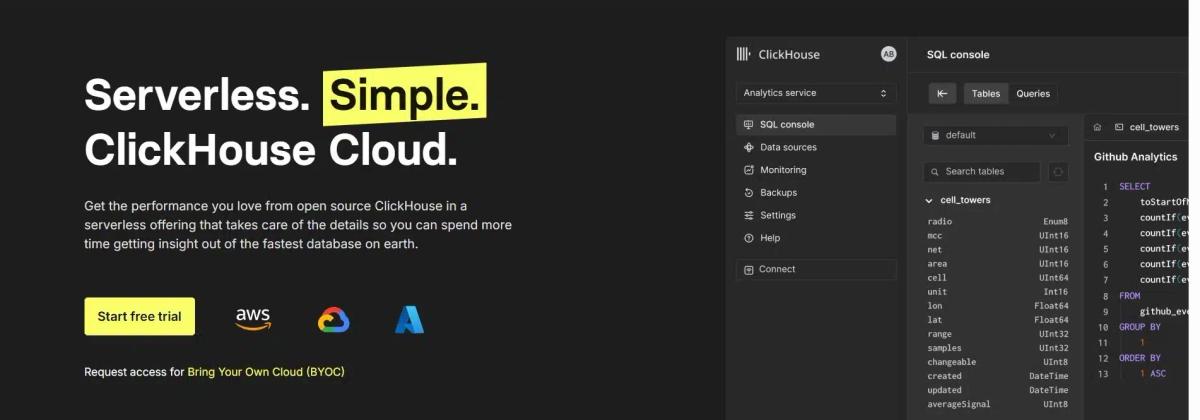
Live dashboards on billions of events demand a columnar engine built for speed. ClickHouse delivers sub-second analytics on fresh data.
Features
- Millisecond-class OLAP at huge scale; Braze and other large-scale MarTech platforms use ClickHouse for real-time, high-volume event analytics.
- Native Kafka integrations; high concurrency for analyst and client dashboards.
Pricing
- Managed service; pay for compute/storage with autoscaling.
When to use
- Instant telemetry, A/B readouts, anomaly detection, and SLA-bound analytics APIs over impression/click logs.
5. Confluent Cloud (Kafka)
Bidstreams, fraud checks, user syncs, real-time runs on events. Confluent gives you Kafka without the ops burden.
Features
- Fully managed Kafka with support for exactly-once semantics (Kafka transactions), Schema Registry, and global scaling.
- Rich connectors and support for Flink/Spark stream processing.
Pricing
- Serverless/clustered usage pricing (throughput, partitions, storage).
When to use
- RTB pipelines, pacing/dedupe, fraud scoring, and near-instant audience updates where milliseconds matter.
6. Cloudflare
Creative loads, pixels, and APIs hit the edge first. Cloudflare accelerates globally and shields against DDoS and bots.
Features
- Global network in 300+ cities / 120+ countries, optimized routing, and data-localization controls.
- Enterprise-grade DDoS mitigation and evolving Bot Management to reduce IVT.
Pricing
- Tiered plans; advanced security/bot tools on Business/Enterprise.
When to use
- Worldwide ad delivery, API acceleration, and compliance-minded performance at the network edge.
7. Fastly
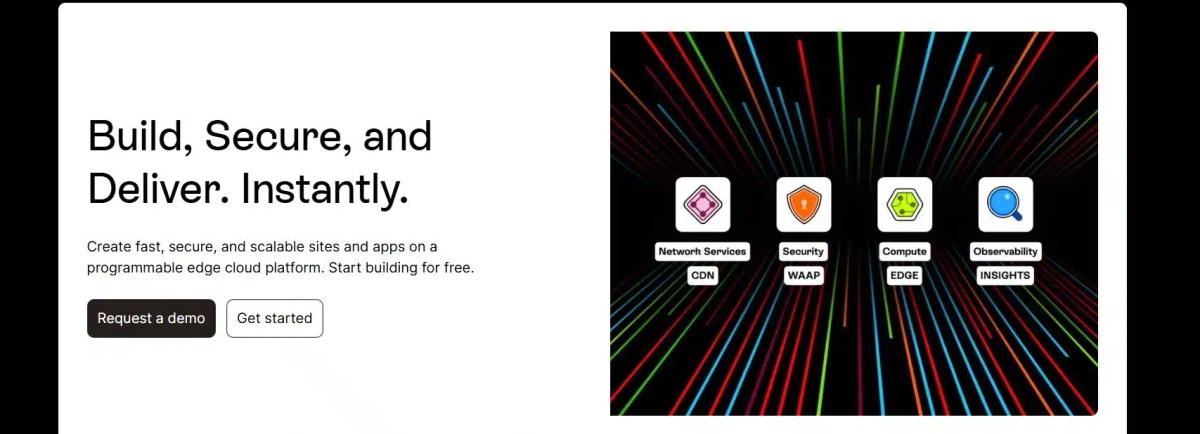
Experiment fast and see results now. Fastly couples instant cache control with live logs, ideal for OTT/CTV and rapid creative iteration.
Features
- Instant Purge with rapid, global purge propagation (typically milliseconds to sub-second, depending on configuration).
- Real-time log streaming to your SIEM/analytics + streaming delivery tooling.
Pricing
- Usage-based (bandwidth/requests); enterprise terms for media-heavy workloads.
When to use
- CTV/OTT delivery, dynamic creative, and teams that tune performance continually with deep, live visibility.
8. Yospace

Addressable live TV needs server-side stitching that doesn’t stall the stream. Yospace has demonstrated sub-5s glass-to-glass latency in low-latency SSAI demos and deployments.
Features
- SSAI with one-to-one targeting in live streams; MPEG-DASH SGAI implementation.
- Demonstrated <5s cumulative latency and support for advanced formats/measurement.
Pricing
- Enterprise licensing based on channels/scale/integrations.
When to use
- Live sports/news CTV where latency, reliability, and addressability must coexist. Yospace.
9. Google Cloud
If your media runs on Google, keep analytics close. BigQuery, Ads Data Hub, andGA4exports tie spend, behavior, and outcomes together.
Features
- GA4 raw event export to BigQuery; BigQuery ML/BI for audience and performance analysis.
- Ads Data Hub to join first-party data with Google event-level ad data in a privacy-safe way (availability is limited; access is typically via your Google account team or approved partners).
Pricing
- BigQuery on-demand or flat-rate; standard GCP services for pipelines/AI.
When to use
- Ads/YouTube/GA4-heavy stacks needing a governed analytics plane and privacy-aware activation.
10. Leaseweb

Need metal performance and global reach with managed help? Leaseweb blends dedicated servers with services built for exchanges and DSPs.
Features
- Global infrastructure with low-latency paths and custom dedicated servers.
- Proven AdTech workloads (e.g., LiquidM treating dedicated servers like cloud).
Pricing
- Monthly per-server; predictable vs. variable egress models; managed options available.
When to use
- Large, steady traffic profiles (bidders, ad servers, analytics collectors) needing control and predictable cost.
How to Choose the Right Hosting for AdTech and MarTech
Choose hosting that keeps latency low, scales with your data, protects user trust, and controls long-term costs. The right mix of dedicated performance and smart services will define your edge.
- Colocation/interconnect: For RTB bidders, placing infrastructure in the same facilities/metros as exchanges can be the biggest latency win.
- Multi-region failover: Use active-active or hot-standby in a second region to keep bidding/live decisioning up during incidents.
Latency
AdTech lives in milliseconds. Every delay hurts revenue and response rates. Deploy infrastructure close to ad exchanges and audiences.
Use bare-metal servers, NVMe storage, and optimized network paths to keep bidder processing fast and predictable. For RTB, size your latency budget to the exchange timeout (OpenRTB tmax) and your network distance.
Scalability
Campaigns peak fast. Your hosting must absorb sudden loads and scale without re-architecture. Choose platforms that separate ingestion, processing, and analytics layers, so each can expand independently.
Security
AdTech and MarTech systems handle sensitive campaign and audience data. Demand DDoS protection, bot filtering, encrypted data transfers, and continuous monitoring. Security failures don’t just slow you down; they burn trust and budgets.
Compliance
Regulations like GDPR and CCPA require clear data governance and operational processes. Keep personal data regional when needed, track data flows, and use clean-room technologies for privacy-safe partner measurement when applicable. A compliant stack isn’t optional; it’s your license to operate.
Total Cost of Ownership
Look past headline prices. Cloud egress fees and overages can inflate costs. For steady, high-volume workloads, dedicated servers consistently deliver better performance per dollar. Use cloud or managed services for burst capacity and peripheral workloads.
Build the Future of AdTech and MarTech on the Right Infrastructure
AdTech and MarTech have officially converged. Modern marketing isn’t just creative, it’s computational. Every impression, click, and conversion runs through an engine of data pipelines, real-time bidding, and analytics. That engine only performs as well as the infrastructure behind it.
Scalable, secure, and low-latency hosting is now the backbone of every competitive AdTech and MarTech stack. The future belongs to teams that treat infrastructure as strategy, not a utility.
Explore the providers in this guide to design a setup that matches your scale, compliance, and data needs. And when you’re ready for custom-built, high-performance dedicated servers, start with RedSwitches.
Our bare-metal architecture, global reach, and performance-first design give you the control, speed, and reliability needed to stay ahead in 2026 and beyond.
FAQ
Q. What is AdTech & MarTech hosting and why does it matter?
AdTech and MarTech hosting provides the performance backbone for tools that power advertising and marketing automation. From real-time bidding engines to customer data platforms, these systems run on data and speed. Reliable hosting ensures low latency, stable uptime, and secure data flow, critical for campaign accuracy, personalization, and ROI. Without it, even strong algorithms fall short.
Q. How is hosting for AdTech/MarTech different from traditional web hosting?
Traditional web hosting handles websites or apps with moderate traffic. AdTech and MarTech stacks, on the other hand, process millions of data points per second. They need dedicated infrastructure with high bandwidth, faster disk I/O, and global reach. Latency and throughput, not page load speed, decide success. These workloads demand specialized hosting that can handle real-time processing and large-scale data analytics.
Q. What are the key technical criteria to evaluate?
- **Latency:**For RTB, your response time must fit within exchange timeouts (OpenRTB tmax) and network distance; for analytics, aim for sub-second queries and reliable freshness.
- Bandwidth: High-volume workloads need 10–100 Gbps unmetered links.
- Security: Always-on DDoS, WAF, and encrypted connections.
- Compliance: GDPR, CCPA, and data-localization support.
- **Reliability:**99.99% uptime and redundant global nodes.
- Scalability: Infrastructure that can grow or shrink with demand.
Q. When should a company choose bare metal over cloud or hybrid?
Go bare metal when you need predictable performance, steady workloads, or direct hardware access, ideal for RTB, DMPs, and analytics pipelines. Use the cloud when flexibility and quick provisioning matter more than cost, like for testing or short-term campaigns. Adopt a hybrid setup by combining dedicated servers for core systems with cloud for overflow or analytics workloads.
Q. How can I choose the right provider for my workload?
- Match your needs with what each host does best:
- Real-time bidding or data streaming: RedSwitches or Confluent Cloud.
- Audience analytics or AI-driven campaigns: Databricks or Snowflake.
- Video, OTT, or global ads: Cloudflare, Fastly, and Yospace.
Hafsa Qadeer
Technical Writer
Hafsa Qadeer is a Technical Content Writer at RedSwitches and a journalist with a background in molecular biology and oncology. She brings research precision to technical writing and SEO strategy, turning complex topics in infrastructure, biotech, and AI into content that informs and engages.
Subnautica Dedicated Server Setup (2026): Nitrox 1.8.1 Guide
Your group has a base to finish and deeper waters to explore, but the next session depends on someone keeping the server online. Can a Subnautica dedicated server give everyone access without that player staying in the game?
Empyrion Galactic Survival Dedicated Server Setup Guide: 2026 Updates
An Empyrion dedicated server keeps your universe online even when every player logs off. But a server can start successfully and still be invisible to players, or ignore a setting you thought you changed.

Squad Dedicated Server Setup: Windows, Linux, Ports and Licensing
Your Squad server can start successfully and still leave players unable to find or join it. The real test comes when players connect, the match fills, and your setup has to handle the load.
Power Your Next Project With Bare Metal
10 min delivery, zero setup fees, and 24/7/365 human engineers across 20+ global locations.