Dedicated Server vs Shared Server
We will compare dedicated servers vs shared servers, covering performance, control, security, ROI, and scalability, to help you choose the best long-term hosting solution.
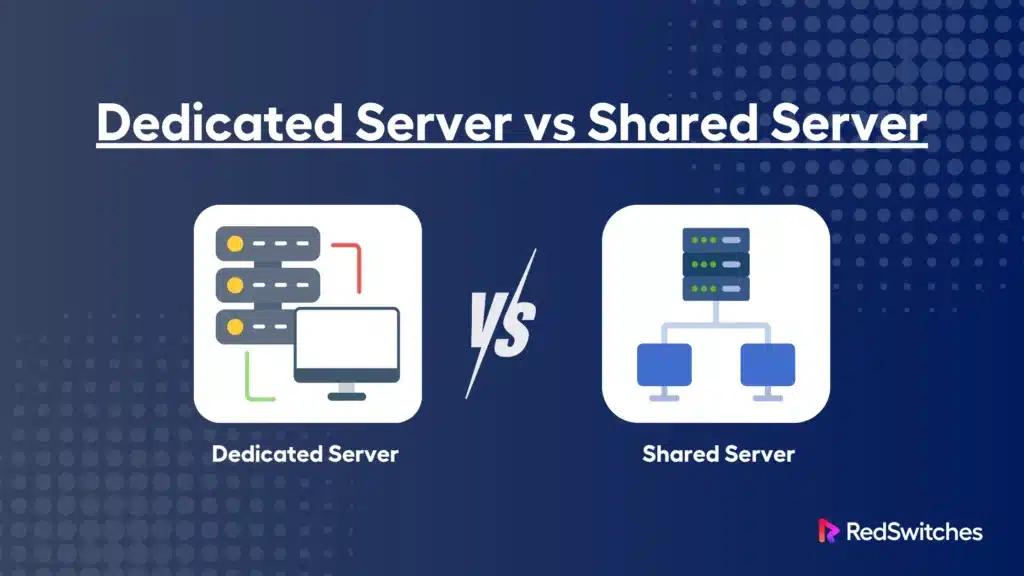
A dedicated server provides you with an entire physical server dedicated solely to your website or application. This setup ensures maximum control, performance, and security, making it ideal for high-traffic sites, complex applications, or businesses that need full customization and resource allocation.
A shared server hosts multiple websites on the same physical server, where resources such as CPU and RAM are shared. Its performance can vary depending on the traffic of other sites.
Whether you’re a small business owner, SaaS founder, developer, agency, or anyone selecting long-term hosting, this guide is tailored for you.
It’s designed to help you understand the strengths and limitations of each option, so you can choose the best solution for your website or application as it grows. Let’s get into the details.
What Is a Dedicated Server?
A dedicated server is a physical machine with all its hardware resources reserved exclusively for your use.
Features
- No virtualization
- Full access to CPU, RAM, storage, and network resources
- Complete control over configurations
Pros
- Full Performance: All resources are dedicated to your workload, ensuring consistent performance.
- **Customization:**You can configure the server exactly as needed.
- Security: With no other tenants on the server, you get enhanced security and isolation.
- **Scalability:**Easily upgrade your resources as your needs grow.
Cons
- Higher Cost: Dedicated servers are more expensive than shared hosting.
- Management: Requires technical knowledge to set up and maintain.
- **Resource Underutilization:**If your traffic is low, you may not fully utilize the server’s resources, resulting in wasted potential.
A dedicated server offers power and flexibility, but it comes with higher costs and increased management responsibilities.
What Is a Shared Server?
A shared server hosts multiple websites on the same physical machine, with each site sharing the server’s resources like CPU, RAM, and storage.
Features
- Multiple websites share the same server
- Limited control over server configurations
- Resource allocation depends on other sites’ traffic.
- Managed by the hosting provider
Pros
- **Cost-Effective:**Shared hosting is significantly less expensive than dedicated hosting.
- Ease of Use: Providers handle server management, updates, and security.
- Good for Low Traffic: Ideal for smaller websites or personal blogs that don’t need heavy resources.
Cons
- **Limited Performance:**Performance may fluctuate due to the activity of other sites.
- **Lack of Customization:**Limited control over configurations and server settings.
- Shared Security: Other sites on the server can pose security risks.
Where Does VPS Fit In?
A Virtual Private Server (VPS) is a middle ground between dedicated and shared hosting. It provides more control and resources than a shared server but is more affordable than a dedicated server.
With a VPS, you get a slice of a physical server, with dedicated CPU, RAM, and storage. You still share the physical hardware with other users, but your resources are isolated, resulting in more consistent performance.
When to use it?
- If you need more power than shared hosting but can’t justify the cost of a dedicated server.
- Ideal for growing websites, apps, or projects that require custom configurations and reliable performance, but are not yet at the level that necessitates full server resources.
Think of it as a stepping stone, offering flexibility and control at a more reasonable price.
Dedicated Server vs Shared Server: Differences Deep Dive
In this section, we’ll break down the key differences between dedicated and shared servers. It will focus on performance, security, customization, cost, scalability, and ideal use cases to help you decide which option best fits your needs.
| Factor | Dedicated Server | Shared Server |
|---|---|---|
| Performance | Full resources dedicated to you | Performance shared with others |
| Security | Fully isolated, high-security control | Shared risks; breach on one site can affect others |
| Customization | Full control over server settings | Limited customization, no root access |
| Cost | Higher upfront cost, best long-term ROI | Low upfront cost, but it can cost more in the long run |
| Scalability | Scalable vertically & horizontally | Limited scalability, forced migration when growth hits |
| Use Cases | Enterprise-grade apps, high-traffic websites | Startups, blogs, and small eCommerce sites |
Performance & Speed
Dedicated hosting gives you the whole engine, no “noisy neighbors,” no throttling during peak hours. You control the entire server, ensuring you get consistent and reliable speed, even during high-traffic periods.
Shared hosting is like carpooling: cheap, but your speed depends on others. With shared hosting, multiple websites run on the same server, so if one site experiences a sudden surge in traffic, it can slow down the others. Your performance is directly tied to the activity of others.
Performance Benchmarks
Under high concurrent load, dedicated servers consistently outperform shared hosting. Dedicated servers handle requests faster, with minimal latency and no resource sharing. Shared hosting struggles with scalability, causing slowdowns when traffic spikes.
Verdict
Dedicated servers are superior, especially for sustained performance. If you need speed, control, and reliability, a dedicated server is the way to go.
Security & Isolation
Dedicated servers are fully isolated. You have exclusive access to all the server’s resources, making it ideal for sensitive data such as finance, healthcare, or enterprise-grade SaaS. With dedicated hosting, you control all aspects of security, reducing exposure to vulnerabilities from neighboring sites.
Shared hosting is cost-efficient but with shared risks. A breach on someone else’s site could threaten yours. In shared hosting, all websites share the same resources, so if one site is compromised, other sites on the same server could also be at risk.
Compliance readiness like HIPAAor PCI-DSS is only possible with full control of the server. You need dedicated hosting to meet these strict requirements and ensure that sensitive data is properly secured.
Verdict
Dedicated is secure by design. If security and compliance are a priority, dedicated hosting provides the isolation and control you need.
Customization & Control
In dedicated server hosting, you have full control. Install what you need, tweak the OS, configure firewalls, run Dockeror Kubernetes, it’s your playground.
Shared servers are limited to what the provider allows. No root access. Configurations are restricted. You can only work with what’s provided.
Verdict
Dedicated is best for developer freedom and infrastructure autonomy. You get the flexibility to set up everything exactly as you need. Shared hosting? Not so much. If you want control, dedicated is the way to go.
Cost (But Frame as Long-Term ROI)
Dedicated hosting provides the best dollar-to-performance ratio over time. As your business scales, you won’t face the bottlenecks that shared hosting brings. You get the performance you need without limitations.
Shared hosting is cheaper up front, but that low price comes with a cost. As your app or store grows, performance limitations can quickly become a problem. Downtime, slow load times, and resource restrictions can lead to lost revenue and frustrated users.
Verdict
While shared hosting may be affordable now, dedicated hosting is a smart investment for long-term growth and reliability.
Scalability & Futureproofing
Dedicated hosting enables you to scale both vertically (by increasing RAM and CPU resources) and horizontally (by adding additional servers). This flexibility enables easier adaptation to evolving needs. Dedicated hosting is designed for long-term growth, edge computing, and handling complex workloads, such as AI, Crypto, and machine learning.
Shared hosting has a ceiling. Once you hit it, you’re forced to migrate to something else, or change your plan often with significant downtime and hassle.
Verdict
Dedicated hosting is built for what’s next. It provides the scalability necessary to support your future growth without the limitations of shared hosting.
Hosting Solutions Tailored to Your Business Stage
No matter where you are in your business journey, choosing the right hosting solution is key to scaling and securing your online presence.
| Business Stage | Recommended Hosting | Reason |
|---|---|---|
| Startup Blog or Personal Website | Shared Hosting | Cost-effective for limited traffic |
| Small Business Website or Portfolio | Shared Hosting | Balance between affordability and functionality |
| Growing eCommerce Store | Dedicated Hosting | Ensures fast transactions, secure data handling, and scalability |
| SaaS MVP (Minimum Viable Product) | Shared or VPS Hosting | Cost-efficient for early development, upgrade as needed |
| Custom Game Server or App Backend | Dedicated Hosting | Requires full control, high performance, and low latency |
| Digital Marketing Agency | Start on Shared Hosting → Move to Dedicated Hosting | Start low-cost, migrate for performance and security |
| Enterprise-Level Applications | Dedicated or Managed Hosting | High availability, compliance, security |
| High-Traffic Media or News Website | Dedicated Hosting | Handles large volumes, ensures fast load times |
| Educational Platforms or Learning Management Systems (LMS) | Dedicated Hosting | Supports resource-intensive apps, secure data handling |
| Financial Services or HealthTech Platforms | Dedicated Hosting | Meets regulatory requirements, ensures data security |
| Crypto Trading or Blockchain Nodes | Dedicated Hosting | Ensures stable, high-performance infrastructure for crypto operations |
| StreamingServices (e.g., Video, Audio) | Dedicated Hosting | Delivers high uptime, large bandwidth, and minimal latency for media streaming |
| RPC Node Hosting (Solana,Ethereum, etc.) | Dedicated Hosting | Supports large-scale, low-latency node operations for decentralized apps |
| Web3Applications or DeFi Projects | Dedicated Hosting | Provides the performance and security needed for decentralized finance apps |
Not Sure Which One You Need?
Answer these quick questions to help determine which hosting solution fits your needs:
Do you expect traffic to grow consistently over the next 6–12 months?
- Yes: Dedicated hosting is better for sustained growth.
- **No:**Shared hosting works fine for now.
Do you want control over the OS, firewall, and software stack?
- **Yes:**Go for dedicated hosting.
- No: Shared hosting will work for you.
Will uptime directly affect revenue or user trust?
- Yes: Dedicated hosting ensures better reliability.
- **No:**Shared hosting is enough for lower-impact sites.
Do you require security compliance (HIPAA, PCI-DSS)?
- **Yes:**Dedicated hosting is essential for compliance.
- **No:**Shared hosting can handle basic security.
Can you or your team handle server management?
- Yes: Dedicated hosting gives you full control.
- **No:**Shared hosting or managed hosting is a better fit.
Migration: Zero-Downtime, Zero-Stress
Migrating to dedicated hosting doesn’t have to be a headache. At RedSwitches, we handle everything, from pre-migration audits to data transfer and DNS cutover, ensuring a seamless transition with zero downtime.
We’ll assess your current workload and help you choose the best dedicated configuration based on your needs. Our experts will assist you every step of the way, ensuring a smooth, stress-free migration process.
Mini Checklist:
- **Backup & Transfer:**We’ll safely back up and transfer your data.
- DNS Propagation Without Breakage: Your site stays online during DNS updates.
- **Firewall & Security Hardening:**We’ll secure your new environment to prevent any vulnerabilities.
- Post-launch Testing: We’ll test everything thoroughly to ensure full functionality.
Our engineers will walk you through every step. Let us handle the technical details so you can focus on what matters.
Final Thoughts
Migrating to a dedicated server is a smart move for long-term growth. Whether you’re facing increased traffic, stricter security needs, or the desire for full control. Dedicated hosting provides the performance and flexibility you need. The migration process can be with zero downtime, as experts handle everything, from pre-migration audits to post-launch testing.
With proper planning and execution, you can expect minimal disruption and stress. Whether you’re upgrading from shared hosting or VPS, the transition can be smooth with the right guidance. If you’re ready to scale, improve performance, and enhance security, migrating to a dedicated server is the next step for your business. Let’s ensure your migration is efficient and successful.
Frequently Asked Questions
Q. How does the security risk differ between shared and dedicated servers?
In shared hosting, multiple websites share the same server. A breach on one site can affect others. Dedicated hosting isolates your server, reducing the risk of vulnerabilities from neighboring sites.
Q. What control options are available on a dedicated server that aren’t on shared hosting?
With dedicated hosting, you have full root access. This allows complete control over the OS, firewall, and software configurations. Shared hosting restricts customization and doesn’t offer root access.
Q. How do response times compare for high traffic on shared vs dedicated servers?
Shared hosting can slow down under high traffic because resources are shared. Dedicated hosting provides exclusive access to all resources, ensuring faster response times even during peak traffic.
Q. In what scenarios would unmetered bandwidth on a dedicated server be most beneficial?
Unmetered bandwidth is ideal for websites with high traffic, video streaming, or large eCommerce stores. It ensures smooth performance and avoids extra costs or slowdowns when data usage increases.
Hafsa Qadeer
Technical Writer
Hafsa Qadeer is a Technical Content Writer at RedSwitches and a journalist with a background in molecular biology and oncology. She brings research precision to technical writing and SEO strategy, turning complex topics in infrastructure, biotech, and AI into content that informs and engages.

BeamMP Dedicated Server Setup Guide (2026)
Build and host a reliable BeamMP dedicated server on Windows or Linux with setup, configuration, optimization, security, and troubleshooting guidance.

ASKA Dedicated Server Setup Guide: 2026
Learn how to successfully install, configure, secure, and troubleshoot an ASKA dedicated server for smooth, persistent multiplayer hosting in 2026.

Wreckfest 2 Dedicated Server Setup Guide 2026
Build a reliable Wreckfest 2 dedicated server with clear, practical steps for 2026 covering installation, configuration, ports, optimization, and troubleshooting.
Power Your Next Project With Bare Metal
10 min delivery, zero setup fees, and 24/7/365 human engineers across 20+ global locations.