Best Linux Dedicated Server Providers
If your apps run on Linux, the right hardware and network matter. We break down the dedicated hosts that stay fast, stable, and cost-effective under load.
A Linux dedicated server is a physical machine reserved entirely for one user, running a Linux OS such as Ubuntu, Debian, AlmaLinux, or CentOS. You get full control over its resources, no sharing with others.
Linux rules the server world for good reason: it is stable, flexible, open source, and cost-efficient. You don’t pay licensing fees, and you can customize it to fit any need. It’s ideal for web apps, SaaS, AI/ML workloads, gaming servers, CDNs, and DevOps pipelines.
Unlike shared or VPS hosting (where resources are split), dedicated means isolation with control. Let’s compare the best Linux dedicated server providers.
Key Takeaways
- Linux dedicated servers offer full resource control without sharing, unlike VPS or shared hosting.
- Entry-level plans in this guide typically start around $35–$70/month, while fully managed or enterprise servers often begin at $200+/month.
- RedSwitches leads with 99.99% uptime and 10-minute deployment in select locations.
- Hetzner offers the best value for European users at a starting price of €37/month.
- Ubuntu Server is one of the most popular Linux distros for dedicated servers.
- Managed servers handle updates and security; unmanaged require technical expertise.
- Cherry Servers and phoenixNAP offer hourly billing for flexible, short-term needs.
- All providers in this list include at least basic network-level DDoS protection on some or all dedicated server lines and support multiple Linux distributions, with paid upgrades available for advanced mitigation in many cases.
- NVMe storage and AMD EPYC/Intel Xeon CPUs are common in modern configurations, even though some entry plans still use HDD or SATA SSD.
- Many providers offer free or low-cost migration assistance when switching to dedicated servers, especially on managed plans.
Top 8 Best Linux Dedicated Server Providers
| Provider | Key Highlight | Best For | Starting Price |
|---|---|---|---|
| RedSwitches | Instant Linux bare-metal, 1–25Gbps, Gen4 NVMe, full IPMI | High-performance global Linux hosting | |
| Liquid Web | Enterprise managed servers + RAID SSD/NVMe | Fully managed Linux environments | around $235/mo* |
| Hetzner | EPYC/Xeon power + low-cost EU bandwidth | Budget-friendly EU compute | |
| OVHcloud | Anti-DDoS + global high-traffic network | Global Linux deployments | |
| InMotion | NVMe RAID + US-optimized routing | US performance & business hosting | |
| Cherry Servers | Terraform/API automation + hourly billing | DevOps & IaC workflows | ~$65/mo |
| phoenixNAP | 20–50Gbps + API-based bare metal | Bandwidth-heavy, ML/compute workloads | $39–40/mo |
| IONOS | Per-minute billing + unlimited traffic | Flexible, cost-controlled Linux servers | around $70/mo |
Note: This comparison is based on plans, prices, and features available at the time of compiling this guide. Providers may change configurations, pricing, or terms over time, so be sure to review the latest information on their sites.
Let’s discuss the best Linux dedicated server providers.
Turn Your Linux Stack Into a Powerhouse
Get off shared hosting and onto real hardware. RedSwitches gives you dedicated Linux servers with full root access, free DDoS protection, and global bandwidth built for SaaS, AI, and high-traffic sites.
1. RedSwitches
RedSwitches delivers instant, high-performance Linux bare-metal servers across the world. Our servers are great for workloads that need speed, stability, and reliable support.
Features
- We provide servers that can be deployed in approximately 10 minutes.
- We support Ubuntu, Debian, AlmaLinux, Rocky, CentOS Stream, custom ISOs, and kernel-level tuning.
- We offer 1Gbps, 10Gbps, and 25Gbpsports, unmetered bandwidth, and optimized routing for low-latency apps.
- Our servers include Layer 3/4 DDoS protection at no extra cost.
- Our servers have Gen4/Gen5 NVMe, hardware RAID, and hot-swap bays for strong IOPS performance.
- We provide IPMI, KVM over IP, OS reloads, remote power control, and full root access.
Pricing
Plans start at $81.68/month for base bare-metal setups.
Best For
Anyone who wants fast deployment, full bare-metal control, Linux flexibility, global bandwidth, and 24/7 support.
2. Liquid Web
Liquid Web focuses on enterprise-class Linux dedicated servers. They target organizations that want strong and reliable infrastructure without managing it in-house. Their platform is built for production environments that need steady performance, reliability, and engineers who watch server health.
Features
- They provide end-to-end server administration. This includes OS maintenance, security rules, patching, and system tuning. These steps help maintain a stable and secure Linux environment.
- They offer enterprise-grade hardware with RAID SSD or NVMe storage. This setup improves resilience and I/O speed.
- They provide redundant networking. It runs on top-tier carriers and supports steady throughput and low latency.
- They do continuous monitoring. Their engineers track usage, uptime, and bottlenecks 24/7.
- They offer root access and optional control panels. This lets teams manage apps while Liquid Web handles the infrastructure.
- They provide integrated backups. These include snapshot recovery for quick rollback and protection.
Pricing
Their fully managed Linux dedicated servers currently start around $235/month on 2-year plans, with lower self-managed promo deals also available (check current offers on their site).
Best For
Organizations that need reliability, expert-managed Linux servers, and steady operational oversight.
3. Hetzner

Hetzner delivers cost-effective Linux bare-metal servers. They offer strong hardware and stable performance. They are popular in Europe due to low pricing, high-core CPUs, and good automation tools.
Features
- They provide AMD EPYC and Intel Xeon processors. These work well for compute, virtualization, large datasets, and container workloads.
- They offer automated provisioning through Robot and Cloud consoles. This allows fast OS installs, reinstalls, and rescue access.
- They provide vSwitch private networking. It helps users build clusters, secure internal networks, and multi-node setups.
- They do support custom ISO installation. This makes custom or hardened Linux builds easy.
- They provide low-cost bandwidth. They offer 1Gbps and 10Gbps ports at very low prices.
- They operate EU-compliant data centers. These centers use renewable energy and have strong cooling and redundancy.
Pricing
Their prices start at about €37/month, depending on the region and setup.
Best For
Users who want strong Linux hardware in the EU at the lowest price. Ideal for developers, teams that scale, and long-running compute tasks.
4. OVHcloud
OVHcloud runs one of the largest bare-metal networks in the world. Many businesses choose them for regional presence, global traffic needs, and multi-continent Linux deployments. Their network is built for heavy workloads.
Features
- They provide built-in Anti-DDoS (VAC). It blocks malicious traffic in all regions at no extra cost.
- They offer high-traffic bandwidth. Billing depends on port speed, not strict metered use.
- They provide vRack private networking. This helps connect servers across data centers in a secure way.
- They do offer dual network interfaces. This separates public and private traffic.
- They offer a wide Linux OS list. This includes Ubuntu, Debian, Rocky, AlmaLinux, Fedora, and custom disks.
- They provide API automation for provisioning, OS reloads, and monitoring.
Pricing
Many of their popular dedicated server plans land around $50–$70/month, with cheaper eco options also available depending on configuration and region.
Best For
Companies that run large Linux deployments, heavy-traffic apps, and distributed systems that need security.
5. InMotion Hosting

InMotion Hosting provides Linux-focused dedicated servers. They target U.S. businesses that need strong performance and reliable routing. They also offer optional managed support.
Features
- They provide NVMe RAID storage for fast read and write speeds.
- They offer Smart Routing Network tech. It finds the best paths across U.S. carriers.
- They provide configurable servers. You can choose unmanaged Linux or managed setups with cPanel/WHM.
- They do free migrations, onboarding help, and performance tuning.
- They provide many Linux distros. These include Ubuntu, Debian, CentOS Stream, and AlmaLinux.
- They offer upgradeable RAM, CPU, and NVMe.
Pricing
Their dedicated server deals currently start around $35/month on introductory offers, with many business-focused plans renewing closer to $70/month.
Best For
U.S. businesses that need strong Linux performance, stable routing, and optional managed services.
6. Cherry Servers
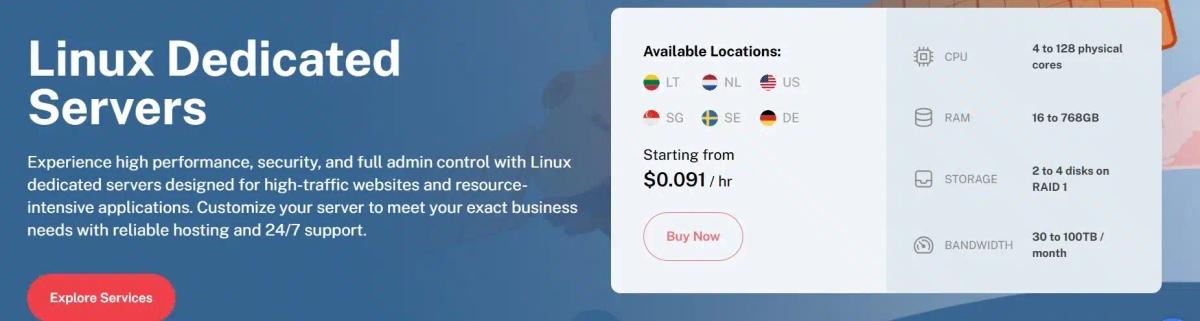
Cherry Servers caters to DevOps teams and engineers who require infrastructure automation, flexible deployment cycles, and programmatic control over Linux bare-metal infrastructure. Their platform is strongly aligned with CI/CD, cloud-native workflows, and time-sensitive compute tasks.
Features
- They provide native Infrastructure-as-Code tools, including Terraform support, a REST API, and Ansible-ready modules.
- They offer fast server deployment, typically provisioning hardware in 15–30 minutes.
- They provide hourly billing, allowing ephemeral Linux environments for CI pipelines, dev/test workloads, or burst compute tasks.
- They do support custom OS images, letting teams deploy custom Linux kernels or hardened configurations.
- They offer private VLANs and subnetting, suitable for cluster networks and secured multi-node Linux environments.
- They provide GPU, high-core, and specialized compute servers for data processing and virtualization.
Pricing
Their instant dedicated servers start from about $0.091/hr (roughly $65/month if used full-time, depending on region and configuration).
Best For
DevOps teams that require automation-friendly Linux bare metal, with on-demand deployment and flexible billing.
7. phoenixNAP
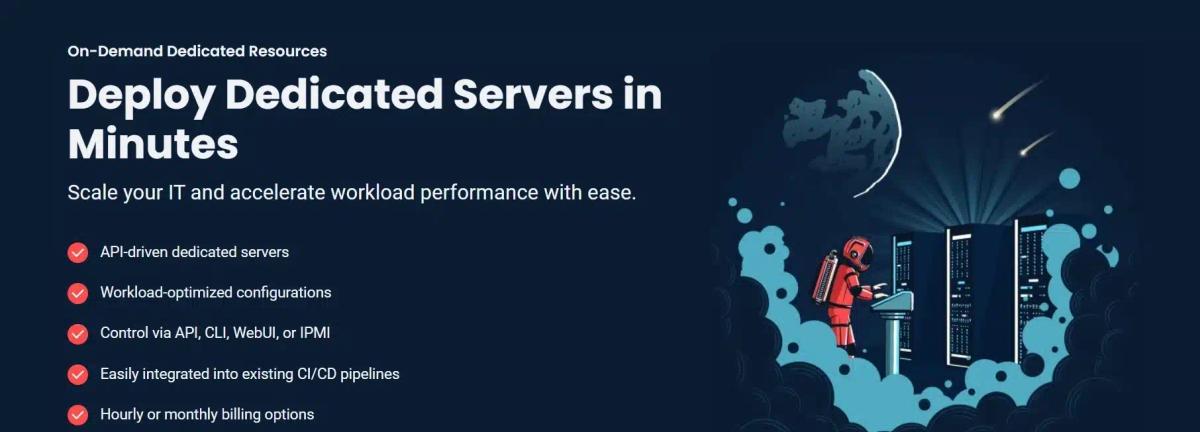
PhoenixNAP offers a hybrid between traditional bare metal and cloud automation, giving Linux users the ability to deploy, scale, and destroy servers programmatically while benefiting from extremely high bandwidth and modern hardware configurations.
Features
- They provide 20–50Gbps network capacity, ideal for bandwidth-heavy applications and distributed Linux services.
- They offer API-driven provisioning that mirrors cloud-style workflows but on dedicated hardware.
- They provide GPU and high-memory builds, supporting data science, ML workloads, and virtualized environments.
- They do offer both hourly and monthly billing, giving cost control for variable workloads.
- They provide automated DDoS protection and security mechanisms across DCs.
- They offer broad Linux compatibility, including custom ISO support.
Pricing
Their pricing starts from approximately $39–40/month for a minimal configuration (hourly-billing equivalent entry plan).
Best For
Teams with high-bandwidth or elastic Linux workloads, such as media processing, ML training, or global distribution engines.
9. IONOS

IONOS provides flexible Linux dedicated servers ideal for organizations that want granular billing and clean, straightforward lifecycle management. Their infrastructure is designed to give users predictable control without long-term commitments.
Features
- They provide true per-minute billing, allowing on-demand Linux compute without monthly contracts.
- They offer modern AMD and Intel CPUs, combined with ECC memory for stability.
- They provide unlimited traffic, with 1Gbps/10Gbps network ports depending on the server class.
- They do offer user-friendly management tools, allowing quick OS provisioning, monitoring, and remote access.
- They provide Linux templates, plus custom ISO installation for specialized systems.
- They offer integrated security, such as firewall rules and isolated networking options.
Pricing
Prices for dedicated servers typically start from around $70/month (with per-minute billing available on bare-metal cloud configurations).
Best For
Users who need flexible billing, clean control panels, and stable Linux hardware without long-term financial commitments.
What to Look for in a Linux Dedicated Server Provider
Choosing the right Linux dedicated server provider requires evaluating more than just hardware specs or price tags. A reliable provider must deliver consistent performance, transparent terms, strong security, and true Linux flexibility. The following criteria outline what matters most when selecting a provider.
Performance Benchmarks
A strong Linux server starts with dependable performance. Look for providers that use modern CPUs (AMD EPYC, Ryzen, Intel Xeon), low-latency RAM, and NVMe storage with high IOPS. Providers that maintain stable throughput and responsiveness under heavy load are better suited for production environments.
Uptime & Network Quality
Network reliability directly impacts application stability. Always check a provider’s uptime guarantee (typically 99.9%–99.99%) and evaluate their global network quality. Low latency, consistent bandwidth, and minimal packet loss across regions indicate a well-engineered network backbone.
Security & DDoS Protection
Security should be built into the platform, not treated as an optional add-on. Choose providers that offer always-on DDoS protection, customizable firewalls, private networking options, and secure data-center compliance. Strong security ensures your workloads remain stable even during attack attempts.
Linux Distribution Support
A good provider should support a wide range of Linux distributions such as Ubuntu, Debian, AlmaLinux, Rocky Linux, and CentOS. Bonus points if they allow custom ISO uploads, kernel access, or bring-your-own-image (BYOI) workflows. This flexibility ensures you can configure your environment to match your exact needs.
Scalability & Automation
Modern workloads often require rapid deployment and dynamic scaling. Look for providers that offer instant setup, API access, Terraform/Ansible automation, and private network configuration. Faster provisioning and automation-friendly environments make it easier to scale without downtime.
Management & Support Quality
Support is a critical differentiator. Prioritize providers offering 24/7 availability, fast response times, and access to knowledgeable Linux engineers. Whether you choose a managed or unmanaged server, quality support ensures smoother operations and quicker problem resolution.
Pricing Transparency
Clear, predictable pricing is essential. Evaluate the provider’s pricing structure, including setup fees, bandwidth rules, hardware upgrades, and renewal terms. Providers with transparent, upfront pricing and no hidden costs offer better long-term value.
FAQs
Q. Which Linux OS is best for servers?
It depends on your setup. Ubuntu Server is the most popular for its stability and large community. AlmaLinux and Rocky Linux are top enterprise choices replacing CentOS. Debian offers long-term reliability, while Fedora Server suits users who want the latest features.
Q. Why do most servers run on Linux?
Linux provides stability, flexibility, and strong security at no licensing cost. It supports automation, containerization, and cloud tools like Docker and Kubernetes while running efficiently on almost any hardware.
Q. How much does a Linux dedicated server cost per month?
Costs vary by hardware and management level. Basic setups start at $40–$70 per month, mid-range plans average $80–$120, and enterprise-grade servers exceed $150 per month.
Q. What’s the difference between managed and unmanaged Linux servers?
Managed servers include OS updates, security patches, and expert monitoring. Unmanaged servers give you full control but require you to handle setup, maintenance, and troubleshooting yourself.
Q. Can I migrate my existing Linux site to a dedicated server easily?
Yes. Most providers offer free migration or guided transfer tools. If your current environment already runs on Linux, the process is quick; files, databases, and configurations move smoothly with minimal downtime.
Hafsa Qadeer
Technical Writer
Hafsa Qadeer is a Technical Content Writer at RedSwitches and a journalist with a background in molecular biology and oncology. She brings research precision to technical writing and SEO strategy, turning complex topics in infrastructure, biotech, and AI into content that informs and engages.

BeamMP Dedicated Server Setup Guide (2026)
Build and host a reliable BeamMP dedicated server on Windows or Linux with setup, configuration, optimization, security, and troubleshooting guidance.

ASKA Dedicated Server Setup Guide: 2026
Learn how to successfully install, configure, secure, and troubleshoot an ASKA dedicated server for smooth, persistent multiplayer hosting in 2026.

Wreckfest 2 Dedicated Server Setup Guide 2026
Build a reliable Wreckfest 2 dedicated server with clear, practical steps for 2026 covering installation, configuration, ports, optimization, and troubleshooting.
Power Your Next Project With Bare Metal
10 min delivery, zero setup fees, and 24/7/365 human engineers across 20+ global locations.