8 Best Dedicated Streaming Servers
Choosing the right server can make or break your streaming project. Viewers expect smooth video, instant starts, and zero downtime. That means your infrastructure, not the player app, is what decides if the stream holds steady.
In this guide, we’ll focus on the backbone roles: origin, packager, and transcoder servers, not end-user apps or CDNs. Origin servers handle inbound encoder feeds; packagers segment and package video; transcoders create multi-bitrate outputs. Different roles have different hardware priorities.
You’ll learn how to compare bandwidth, GPU support, storage, and DDoS protection across providers, and which specs matter for live versus on-demand video.
We’ll also show you where streaming dedicated servers shine, handling 1080p and 4K delivery, scaling to global audiences, and giving you predictable costs. By the end, you’ll know how to match server features to your use case with confidence.
Key Takeaways
- For YouTube Live (H.264), 1080p is ~10–12 Mbps, and 4K ~30–35 Mbps. Twitch commonly targets ~6 Mbps for 1080p.
- CPUs can handle 720p–1080p and light 4K, but multi-rendition 4K/HEVC/AV1 scales far better on GPUs (NVENC).
- Unmetered bandwidth plans offer predictable monthly costs without surprise overage charges.
- Use always-on DDoS (≥20 Gbps inline) and pair with CDN/edge scrubbing for larger attacks.
- RedSwitches offers a strong combination of high-speed ports and GPU-ready transcoding servers.
- DataPacket offers enterprise-grade infrastructure with a 270+ Tbps backbone across ~62 locations for massive-scale operations.
- Cherry Servers includes up to 100 TB of free outbound traffic per server, with low overage (site lists ~$0.565/TB).
- Size ports via: required port ≈ (avg rendition bitrate × concurrent viewers) × ~1.2. Example: at 6 Mbps, 10 Gbps sustains ~1,600 direct viewers; a CDN offloads most egress from origin.
- Start with one origin server and add regional nodes as your audience grows globally.
- Choose server locations close to your target audience for optimal streaming performance.
8 Best Dedicated Streaming Server Providers
| Provider | Key Strengths | Best For | From Price |
|---|---|---|---|
| RedSwitches | 10–100 Gbps, GPU-ready, global DCs | High-traffic, 4K transcoding | $55–$60/mo; $300+ |
| ServerMania | Unmetered 10 Gbps and 2×10 Gbps options available, flexible specs | Steady traffic, live video | |
| DatabaseMart | Budget GPU servers, 500 Mbps–1 Gbps ports | OBS/FFmpeg, VOD libraries | |
| Evoluso | Offshore, 1–20 Gbps ports | EU/IPTV, privacy-friendly use | |
| phoenixNAP | Bare Metal Cloud with free 20 Gbps DDoS protection | Scalable multi-region events | $67–$300/mo |
| DataPacket | 270+ Tbps backbone, 10–100 Gbps | OTT, sports, global scale | Quote-based; varies by region, port speed, and hardware |
| Cherry Servers | Up to 100 TB free outbound, 10 Gbps ports | EU/US VOD, 24/7 streaming | $65–$150/mo |
| Liquid Web | Managed servers, 99.99% uptime | Enterprises, compliance-heavy | $199–$299+ |
Note: Port speeds (10 Gbps, 20 Gbps, etc.) refer to physical network capacity, not bandwidth per viewer. Actual application bandwidth depends on bitrate per stream × concurrent viewers. For example, 1,000 concurrent viewers at 5 Mbps each = ~5 Gbps egress (well below a 10 Gbps port).
Let’s discuss the best dedicated streaming servers.
Your Fastest Exit From Buffering
Move to streaming-ready bare metal with high-speed ports, GPU transcoding, and global routes from RedSwitches. Scale smoothly without surprises.
1. RedSwitches
You want servers that can power high-bitrate video encoding, deliver 4K or multi-bitrate 1080p, and stay online even during traffic spikes. RedSwitchesbuilds for exactly that: origin, packager & transcoder roles with no bottlenecks in network, hardware, or delivery.
Key Features:
- 10 Gbps unmetered ports (and options up to 100 Gbps in select locations). Traffic isn’t capped by volume, only by port speed.
- Latest AMD EPYC, Ryzen, Threadripper & Intel Xeon CPUs; GPU-ready servers (NVIDIA H100, A100, etc.) for heavy transcoding or format conversion.
- 99.99% uptime SLA. Global data centers with fast setup, some servers provisioned in under 10 minutes.
- Transparent pricing. Zero setup fees; supports crypto payments. Comes with enterprise support / dedicated account manager.
Best For:
- Streaming platforms that need predictable throughput and capacity for high concurrent viewers.
- Workflows that demand real-time or heavy transcoding (multiple outputs, modern codecs).
- Live events or VOD services that require fast deployment and global reach.
- Teams that want a provider who handles uptime, network reliability, and high port speeds so they can focus on content.
Pricing:
Starts around for entry bare metal in the EU; production-grade 10 Gbps unmetered GPU servers typically $300–$600+ monthly.
2. ServerMania
You want a dedicated server for streaming that delivers unmetered bandwidth with serious port speeds and solid hardware, without breaking the bank. ServerMania gives you for media streaming what you need: high throughput, flexibility, and strong network performance.
Key Features:
- Offers unmetered servers with 10 Gbps or dual-10 Gbps ports to handle large outbound volume.
- Allows customization of hardware (CPU, RAM, storage) and bandwidth tailored to streaming demands.
- Supports all major streaming software (RTMP, HLS, FFmpeg, Nginx, etc.).
- Strong network uptime SLA; multiple global locations to reduce latency.
Best For:
- Streaming platforms with steady high traffic that want predictable performance.
- Live-video providers who need high outbound throughput and low latency.
- Those who want to tune hardware to use-case (e.g. many concurrent encodes or high bitrate VOD) without vendor lock-in.
3. DatabaseMart
You need flexible servers to handle both GPU-driven transcoding and large VOD libraries on a tight budget. Databasemart offers that mix: choice of GPU-oriented or SSD/NVMe dedicated servers with moderate port speed and transparent pricing.
Key Features:
- Multiple GPU-enabled options (consumer and professional cards) with 32–128 GB RAM. (Note: Verify current GPU inventory on their website, as models change frequently.)
- Suitable for live transcoding or FFmpeg/OBS workflows.
- Plenty of NVMe/SSD + larger SATA storages in many plans. Dual storage tiers allow hot content (video segments/live output) on fast NVMe, archives on cheaper HDD/SATA.
- Typical GPU server ports: 500 Mbps–1 Gbps (plan-dependent).
- OS flexibility (Windows/Linux), SSD/NVMe, and multiple GPU acceleration choices make it good for streamers who need to test or run specific encoding software.
Best For:
- Small to medium streamers who need to transcode or encode video with GPUs (e.g. live multi-bitrate or OBS workflows).
- VOD services with moderate traffic that need solid storage (fast + archival) but don’t yet need 10 Gbps ports or enterprise backbone.
- Projects experimenting or growing: Databasemart’s lower entry cost and incremental upgrades make it good for staging before scaling up.
Pricing:
GPU servers from $149/month. Entry SSD servers are cheaper; premium GPU builds are higher.
4. Evoluso
You require top bandwidth with privacy, fast deployment, and offshore flexibility. Evoluso builds video servers with those priorities: high-capacity ports, anonymity, and network performance for real traffic.
Key Features:
- Stream-dedicated servers from 1 Gbps up to 20 Gbps, unmetered in many plans.
- Hardware specs range from large: high-core count CPUs (e.g., AMD EPYC), NVMe storage, and large RAM.
- High-capacity 1–20 Gbps ports (many unmetered plans) and low-latency EU network. Optimized infrastructure for streaming, IPTV, and live video.
- Offshore locations (Netherlands, Sweden, Switzerland), privacy features (anonymous or crypto payment in some cases).
Best For:
- Audiences in Europe or globally, where you want high performance + privacy.
- Entities hosting content that may be restricted in some jurisdictions need offshore/anonymous options.
- High-traffic live streaming or IPTV workflows need multi-gigabit egress and low latency.
Pricing:
From €120–€150/month (1 Gbps). 10–20 Gbps high-capacity servers €400+/month.
5. phoenixNAP
If you want dedicated servers that feel cloud-like (fast scaling, many regions) but fully bare metal under the hood, phoenixNAP is built for that. Good for streaming origins, transcoding nodes, and flexible deployment.
Key Features:
- Bare Metal Cloud with monthly free outbound bandwidth (15 TB standard in most regions; varies by location, e.g., 5 TB in Singapore) with 20 Gbps or 50 Gbps network options (bonded 2×10 or 2×25), plus included bandwidth by region. Overage traffic is billed separately.
- Free 20 Gbps DDoS protection bundled with each dedicated server.
- Strong network designs (20 or 50 Gbps options, region-dependent), next-gen hardware, API/CLI automation for fast deployments.
- Flexible billing: hourly, reserved, with bandwidth bundles beyond free allotments.
Best For:
- Live streaming events where you need both performance and cost-efficiency.
- Workflows that scale: You may want to deploy many servers across regions as the audience grows.
- Transcoding or origin servers that require strong DDoS protection and generous base bandwidth, with the ability to grow.
Pricing:
Entry Bare Metal Cloud from $0.10/hr (~$67/month). Dedicated streaming servers range $300–$800/month, depending on port speed and region.
6. DataPacket
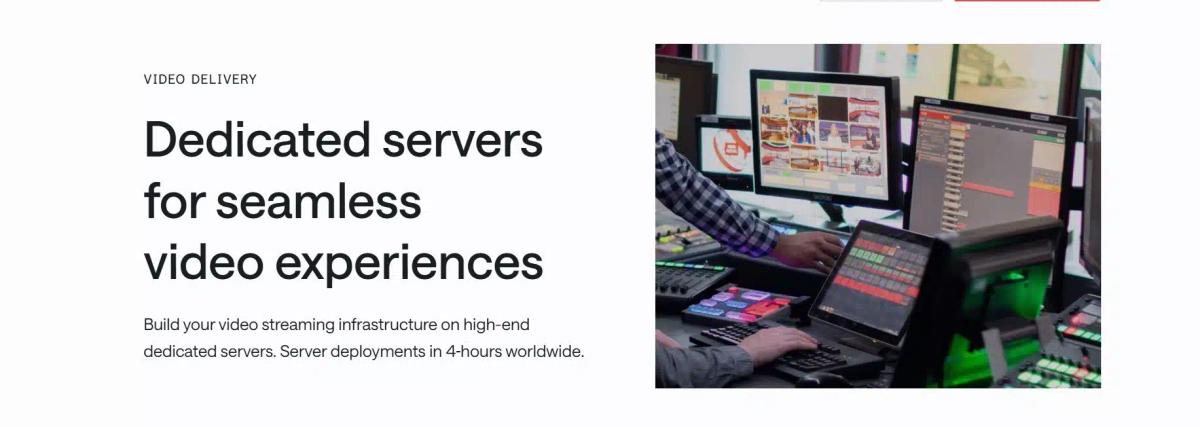
If global scale and extreme bandwidth headroom matter most, DataPacket is the premium choice with one of the world’s largest backbones.
Key Features:
- 270+ Tbps backbone; ~62 global locations.
- 10 Gbps to 2×100 Gbps unmetered uplinks per server.
- Low-latency routing via 16+ Tier-1 providers.
- Enterprise DDoS protection and SLAs.
Best For:
- OTT giants, CDNs, and sports broadcasters streaming to millions.
- Platforms needing multi-region origins and guaranteed uptime.
Pricing:
Quote-based; varies by region, port speed, and hardware. Expect premium pricing for 10–100 Gbps unmetered.
7. Cherry Servers
You need low-latency delivery, hefty traffic allowances, and flexibility in hardware for streaming tasks. Cherry Servers delivers origin and packager power with price predictability and strong performance.
Key Features:
- Up to 10 Gbps dedicated bandwidth; Up to 100 TB free outbound; extra egress from ~€0.5/TB (site currently lists ~$0.565/TB).
- CPU options include the latest AMD EPYC, Ryzen, and Threadripper lines. High core counts, NVMe SSD storage that supports fast reads/writes required for VOD, recording, or buffering.
- Global infrastructure in major hubs (Amsterdam, Frankfurt, Chicago, etc.), low latency, premium backbone carriers. Hourly billing available; deployable in ~15 minutes.
- Crypto payments accepted; support 24/7; strong reputation for reliability in their streaming-server line. cherryservers.com
Best For:
- Projects running 24/7 channels or VOD libraries in EU/US regions where traffic costs matter.
- Use cases needing multiple CPU cores and fast storage for encoding, segmenting, and packaging.
- Teams wanting trial deployments or flexibility (hourly billing) before committing long-term.
- Platforms where predictable egress pricing and strong network quality deliver better ROI than the cheapest per-GB but unreliable options.
Pricing:
Starts $65/month for basic hourly plans. Streaming servers with 10 Gbps ports typically $150–$250/month.
8. Liquid Web
You prefer hands-off reliability, high uptime, and strong support paired with solid hardware. Liquid Web combines robust infrastructure, managed service options, and security to keep your streaming origin/packager/transcoder roles stable.
Key Features:
- Bare-metal dedicated servers with 99.99% uptime and standard DDoS protection; U.S. core data centers (additional locations vary by offer).
- Entry self-managed plans: e.g., 4 cores, 16 GB RAM, 2×480 GB SSD, 10 TB bandwidth.
- Fully managed servers with higher specs: up to 32 cores, NVMe storage, larger bandwidth allocations (10–15 TB standard) with optional bandwidth upgrades.
- Strong security features (ServerSecure hardening), multiple control panels (cPanel, Plesk, etc.), and support.
Best For:
- Businesses that need “set and forget” streaming origin infrastructure with expert support.
- VOD platforms or live streamers who don’t want to manage every server detail.
- Use cases where security, compliance, and uptime are non-negotiable (e.g., enterprise, regulated content).
Pricing:
Starts at $199/month (self-managed). Fully managed higher-spec servers $299–$399+/month.
Note: All specifications, features, and pricing were verified from official provider listings at the time of research. Please confirm with individual providers for the latest updates.
Decision Framework: Match Your Use Case to a Provider
Choosing a streaming server isn’t just about specs. The best provider depends on your workflow, audience, and scale. Use this framework to align your use case with the right infrastructure.
Storage Strategy by Use Case
Live Streaming: Minimal persistent storage needed. Origin servers require 100 GB–1 TB for real-time segment buffering only; segments are deleted after packaging.
VOD Libraries: Tiered storage is essential. Hot content (recently accessed videos) on NVMe/SSD for fast delivery; cold archives on SATA HDD or object storage (S3) for cost efficiency.
Live Sports & Events
Spikes can crush weak origins. Use a CDN to move egress to the edge, and size your origin port via bitrate × concurrent viewers × ~1.2. Keep 25/40/100 Gbps options on standby for edge ingest or multi-region overflow.
This keeps video smooth when thousands join at once. RedSwitches are ideal here, both deliver high-throughput, low-latency networks ready for peak loads.
Always-On Channels
Running 24/7 IPTV or continuous live channels? Your priority is unmetered bandwidth and robust DDoS protection. Predictable pricing and nonstop uptime matter more than anything else. RedSwitches lead in this space with unmetered pipes and always-on mitigation that keeps streams steady.
Transcoding-Heavy Workflows (4K / HEVC / AV1)
If your workflow involves multiple renditions or modern codecs, you need GPU-ready bare metal or a scalable GPU pool. CPUs can handle light 4K, but full 4K ladders are far more efficient and practical on GPUs. RedSwitches offers NVIDIA H100/A100 servers, DatabaseMart covers budget GPU builds, and ServerMania fits when you need both GPU power and fat ports.
EU vs. NA Audiences
Latency and compliance depend on where your viewers are. For European audiences, Cherry Servers and Evoluso give strong local presence and clear traffic pricing. For North America, RedSwitches and phoenixNAP deliver low-latency origins with strong DDoS protection and wide coverage.
Still not sure what fits? Talk to our engineers and we’ll size the right mix of ports, GPUs, and regions so your streaming stack is built to last.
FAQs
Q. How much bandwidth do I need for 1080p/4K live?
A single 1080p stream needs 5–8 Mbps; 4K streams require 25–34 Mbps (depending on frame rate and codec). Multiply by concurrent viewers (not total daily viewers) to size your origin port. For example: 1000 concurrent 1080p viewers × 5 Mbps = ~5 Gbps egress, which fits a 10 Gbps port with safety margin. Note: Adaptive bitrate (ABR) and CDN caching reduce actual origin bandwidth demand.
Q. When do I need a GPU for transcoding vs CPU?
CPUs can handle single 720p–1080p encodes (and light 4K) at moderate bitrates, especially with H.264.
Use GPUs when you need scale or efficiency: multi-rendition ladders, 1080p60 at high concurrency, 4K/60, or modern codecs like HEVC/H.265 or AV1 with low latency.
NVIDIA NVENC (A-/H-series, L-series) is the common choice on servers and dramatically reduces per-stream CPU load.
CPU-only is still fine for simple origin/packager roles or low-volume VOD prep; for live 4K or many renditions, go GPU.
Q. What DDoS protection features matter for streaming stability?
Look for always-on filtering (≥20 Gbps inline), plus CDN/edge scrubbing and multi-region mitigation so volumetric attacks are absorbed before reaching origin.
Q. How do I calculate concurrent viewers vs. total viewers?
Concurrent viewers = people actively watching at the same peak moment. Total viewers = cumulative across an entire day/week. Concurrent viewers drive origin and port capacity needs. For example: 10,000 total viewers might peak at only 500 concurrent (5% concurrency rate typical for scheduled events). Always size infrastructure for concurrent peak, not total.
Q. Can I start small and scale to multi-region?
Yes. Begin with one origin. Add nodes in new regions as viewers grow. A CDN helps expand reach without overloading origins.
Q. How to set up a dedicated stream server hosting for live events?
Install streaming software (Nginx-RTMP, Wowza, or similar). Configure input (encoder feed), define output renditions, and connect to your CDN for delivery.
Q. What hardware specifications are ideal for high-quality streaming servers?
For origin/packager roles: 8–16 cores, 64 GB ECC RAM, NVMe storage, and 1–10 Gbps ports. Size viewers by port: viewers ≈ port (Mbps) ÷ avg bitrate.
At 6 Mbps, ~160 viewers on 1 Gbps and ~1,600 on 10 Gbps (before ~20% headroom).
For 4K or multi-rendition encoding: 16+ cores, 32–64 GB RAM, GPU acceleration (e.g., NVIDIA A100/H100/L-series), and 10+ Gbps ports. For a basic single 1080p stream, 4 cores/16 GB RAM can suffice.
Hafsa Qadeer
Technical Writer
Hafsa Qadeer is a Technical Content Writer at RedSwitches and a journalist with a background in molecular biology and oncology. She brings research precision to technical writing and SEO strategy, turning complex topics in infrastructure, biotech, and AI into content that informs and engages.
BeamMP Dedicated Server Setup Guide (2026)
Build and host a reliable BeamMP dedicated server on Windows or Linux with setup, configuration, optimization, security, and troubleshooting guidance.
ASKA Dedicated Server Setup Guide: 2026
Learn how to successfully install, configure, secure, and troubleshoot an ASKA dedicated server for smooth, persistent multiplayer hosting in 2026.
Wreckfest 2 Dedicated Server Setup Guide 2026
Build a reliable Wreckfest 2 dedicated server with clear, practical steps for 2026 covering installation, configuration, ports, optimization, and troubleshooting.
Power Your Next Project With Bare Metal
10 min delivery, zero setup fees, and 24/7/365 human engineers across 20+ global locations.